5.1History of Knot Tabulation
Mathematical interest in knots was brought to the forefront of mathematics and physics during the 1860s by Lord Kelvin. A central area of research in physics during the 1860s was the investigation of the fundamental building blocks of matter: the atoms. Lord Kelvin hypothesized that atoms were knotted vortices in the aether 1. With this hypothesis, a natural next step is the creation of a table of the elements which, by hypothesis, was a table of knots.
5.1.1Knot Tabulation by Hand
With Lord Kelvin’s vortex hypothesis as the driving force for knot tabulation, the first knot table was produced, via hand computation, by P.G. Tait. Tait’s first table, completed in the 1860s, contained prime knots (described in Section 5.2.3) up to seven crossings 2, a table of the first seven knots can be seen in Figure 1
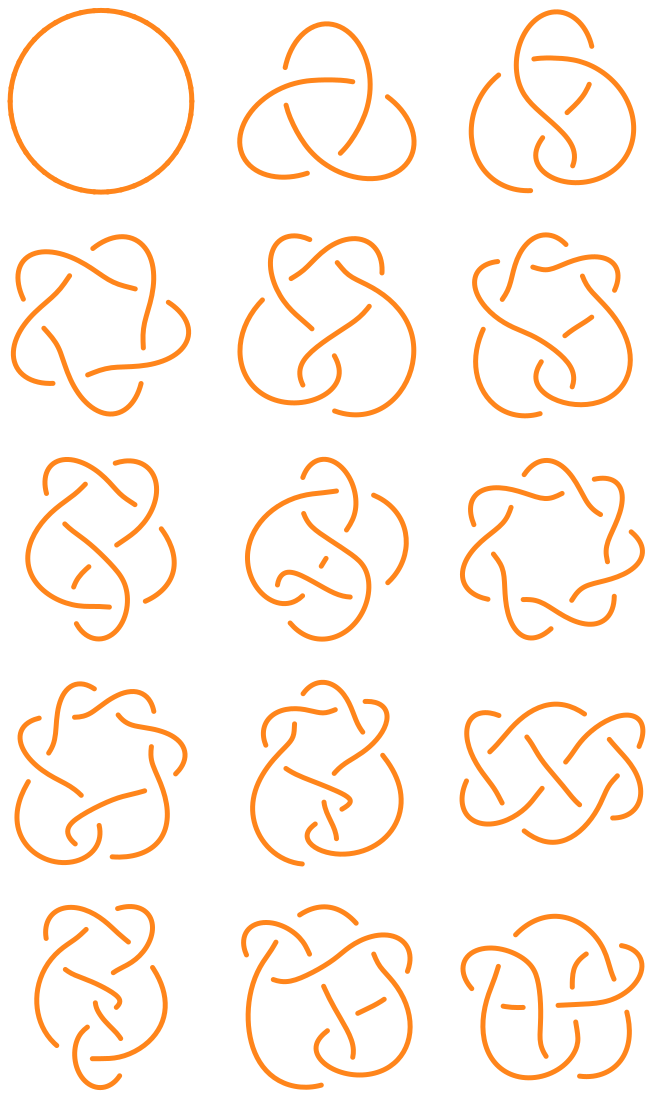
Figure 1:A table of the first seven prime knots. 3
With a table of seven crossing knots complete, Tait’s work in knot tabulation continued, alongside Kirkman and Little 456, for the next 25 years. The trio ultimately constructed a complete list of prime knots up to ten crossings (250 knots + 1 repeat). When the knot theoretic machinery available at the time is considered, the completion of these tables with such high accuracy was a Herculean task. The tables contained a single error, two equivalent (described in Section 5.2.2) ten crossing knots (Figure 2), identified in 1974 by Perko, an amateur mathematician 7.
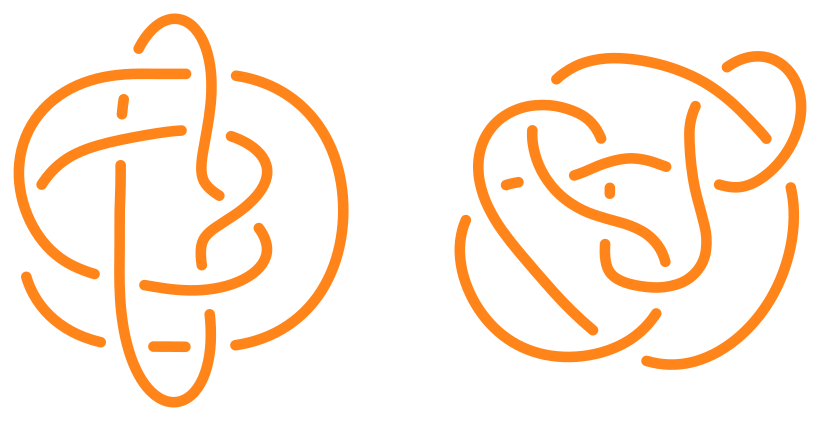
Figure 2:The Perko pair, a pair of equivalent ten crossing knots appearing as an error in early knot tables 37.
After the completion of the ten crossing tables, efforts in knot tabulation stagnated, with few concerted efforts and little progress being made in expanding the tables. The next researcher to take up the tabulation torch was Conway in the 1960s 8. Conway, in “a few hours” 8, tabulated knots to eleven crossings, with only four omissions9. Conway’s work continued by hand computation but employed a novel approach to tabulation. He described decompositions of knots into building blocks, which he called tangles8. Conway paired this with a calculus to glue the blocks together. Under Conway’s tangle calculus, the combinatorial work of knot tabulation became a game of building from simple to complex. Inspired by Conway’s strategies, a second effort to enumerate eleven crossing knots was carried out by Caudron 9, verifying Conway’s findings and rectifying the four omissions. Caudron’s confirmation of the eleven crossing tables marked the final chapter in the hand computation era of knot tabulation.
5.1.2Knot Tabulation by Computer
With advancements in manufacturing in the early 1980s, electronic computers became closer to commodity products. This allowed for researchers of diverse backgrounds and interests to take their crack at time-consuming computational tasks. One of these computational tasks was the construction of knot tables. The first to construct a knot table by computer were Dowker and Thistlethwaite in 1983 10, who produced a table of all prime knots to thirteen crossings. The pair implemented a novel two pass approach that has served as an outline for all major efforts that have followed. The process begins with a first pass to enumerate all possible knot diagrams (described in Section 5.2.1). This is followed by a second pass where “sufficient invariants to distinguish them (knots) from each other” 10 are computed. This effectively assigns knots to equivalence classes (bins [1]), hence finding and removing all duplicate entries from the list (deduping [2]).
The next table produced by computer, knots up to sixteen crossing, was given by Hoste, Thistlethwaite, and Weeks 11 in 1998. Their process deviates only slightly from the earlier approach of Dowker and Thistlethwaite by leaning on heuristics[3] to limit the duplicates found in their first pass. This preprocessing in the first pass allowed Hoste, Thistlethwaite, and Weeks to compute their table in one to two weeks of wall time[4].
The most recent computational effort was carried out by Burton in 2020 12, finding knots to nineteen crossings. Burton’s program closely followed the two pass process, with further heuristic work to preprocess in the first pass and heavily relying on the hyperbolic volume invariant for the second pass. The computation of the nineteen crossing table required months of wall time on a cluster[5], serving as an important signpost for the time requirement problems of knot tabulation.
5.1.3Tangle Tabulation
Conway’s tangle construction allowed him to quickly and effectively tabulate knots by hand. These building blocks of knots are interesting mathematical objects in their own right, however tabulation efforts for tangles have been sparse. The importance of the creation of a large table of tangles has been called:
“The Most Important Missing Infrastructure Project in Knot Theory” - Bar-Natan 13
As it stands, tables of tangles have been generated by hand up to seven crossings by Kanenobu, Saito, and Satoh 14. Computer driven efforts have been undertaken by several members of the University of Iowa Applied Topology (UIAT) group namely Conolly 15, Bryhtan 16, and this thesis. Separately, a table of algebraic tangles has been produced by Gren, Sulkowska, and, Gabrovšek17. Their tabulation is built on a binary operation tree based on Conway’s 8 tangle calculus. Similar binary operation trees can be seen in Conolly 15, Caudron 9, and discussed in (#sec-monttang).
5.2Foundations of Knots
We now begin a more formal description of the foundations of the theory of knots. Our treatment will begin with the general definition of knots, as well as similar knot-like objects. Next, we will discuss ways in which two knots can be considered equivalent. With this, we’ll give an example of a common invariant for knots. Finally, we conclude with descriptions of the notational strategy that inspired the rest of this thesis, the Conway notation.
5.2.1Definition of a Knot
As with anything, we must start with a definition, here we give one for a proper knot.
With some consideration, we can see this definition aligns with our intuitive description of a knot given in Section 4.1. We note that this definition gives two choices for ambient space, for this thesis we will prefer as an ambient space, the preference will become clear in later sections. A natural extension of the concept of a knot is to allow for more than a single component to be embedded into the ambient space. This allowance gives us the concept of a component link.
Playing with this three-dimensional construction for knots, it will quickly become apparent that three-dimensional knots are unwieldy to work with. To simplify our work, we will now build a two-dimensionally encoded model for knots, a knot diagram. We start by taking a knot . We then select a such that lies fully in the interior. Now, for any plane that lies tangent to , we take an orthogonal projection of the knot onto the plane. We require that the projection have no degenerate crossings, intersections of the knot projection where more than two points are collinear or where the crossing is not transverse. We call this projection a knot shadow, an example can be seen in Figure 3. A knot shadow is interpreted as a planar graph[6], with points where strands overlap (are collinear in the projection) as vertices and edges of the shadow as the strands between the overlaps.
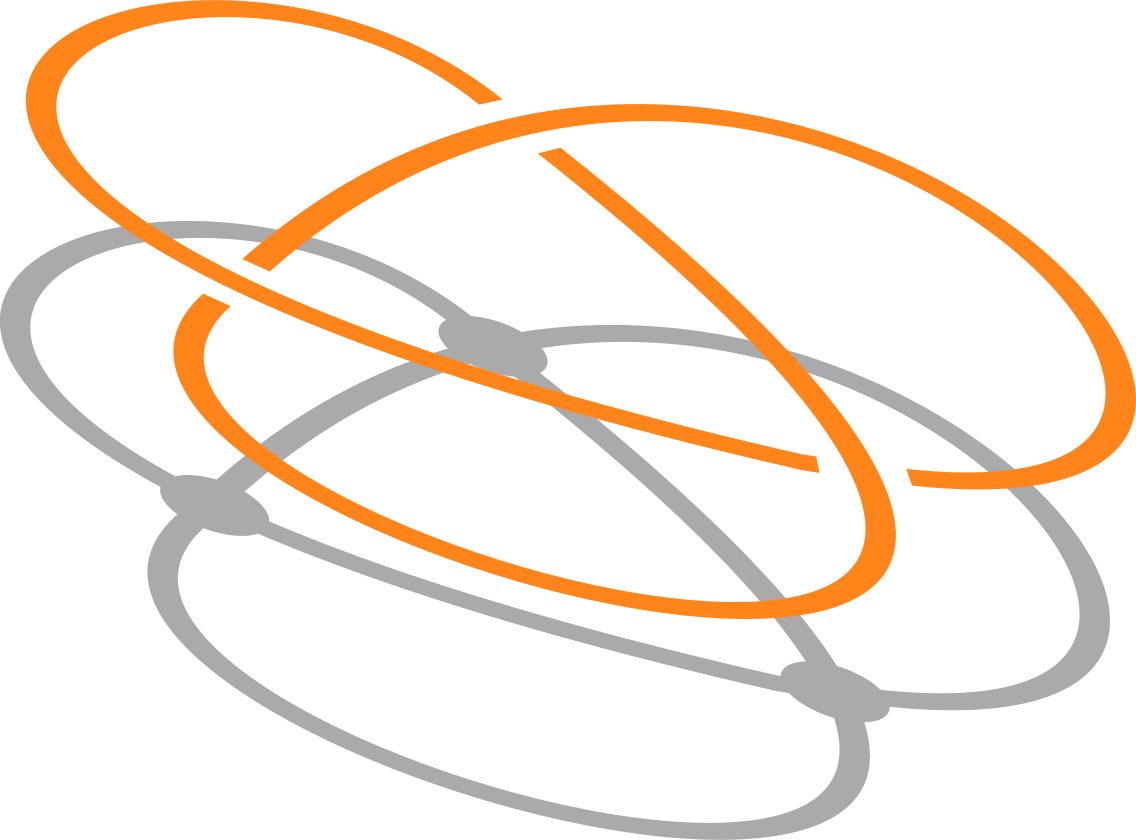
Figure 3:A schematic diagram demonstrating a knot (orange) and its shadow (grey). Imagine a light shining from above the knot onto a piece of paper. The knot shadow is the shadow cast on the paper.
Taking only the shadow of a knot we lose some data that is intuitively important, the crossings of a knot (the relative distance of collinear points). To recover this data in a diagram, we split the edges of the shadow where the strand closer to the projection plane appears to travel under the edge corresponding to the strand further from the plane. We call the edge that is split the under strand, and the non-split strand the over strand. These augmented knot shadows are called knot diagrams and will serve as our primary schematic model for knots throughout this thesis. We call the count of crossings in a knot diagram the crossing number of the knot diagram.
We finish with naming a knot with particular significance, the knot with no crossings in its diagram is called the unknot.
5.2.2Knot Equivalence
Armed with the formal definition of a knot, we can make our first progress in answering the overarching question from Section 4.1.
How do I tell two knots I make apart?
To tell two knots apart, we need to discuss the concept of sameness, that is, what is equivalence in knots. Our concept of equivalence for knots is given by ambient isotopy, and equal knots are said to be ambient isotopic.
When working with the three-dimensional model of a knot, writing down explicit ambient isotopies is, in general, quite difficult. As we did in Section 5.2.1, we can simplify the concept of equality by moving ambient isotopy to an equivalence of knot diagrams. Taking the orthogonal projection model for knot diagrams given in Section 5.2.1, ambient isotopy can be modeled as three Reidemeister moves on diagrams 20. Meaning, two knots are ambient isotopic if and only if their diagrams are equal under a chain of Reidemeister moves 20 and isotopies.
The first Reidemeister move we will define is the Type I move 20. To carry out the Type I move (Figure 4), start by taking a portion of a diagram with no crossings, then add a half twist. When adding the twist, we have two choices; twist into (left handed) or out of (right handed) the plane the diagram lies in. In either, we can freely remove the new crossing by twisting in the opposite direction.
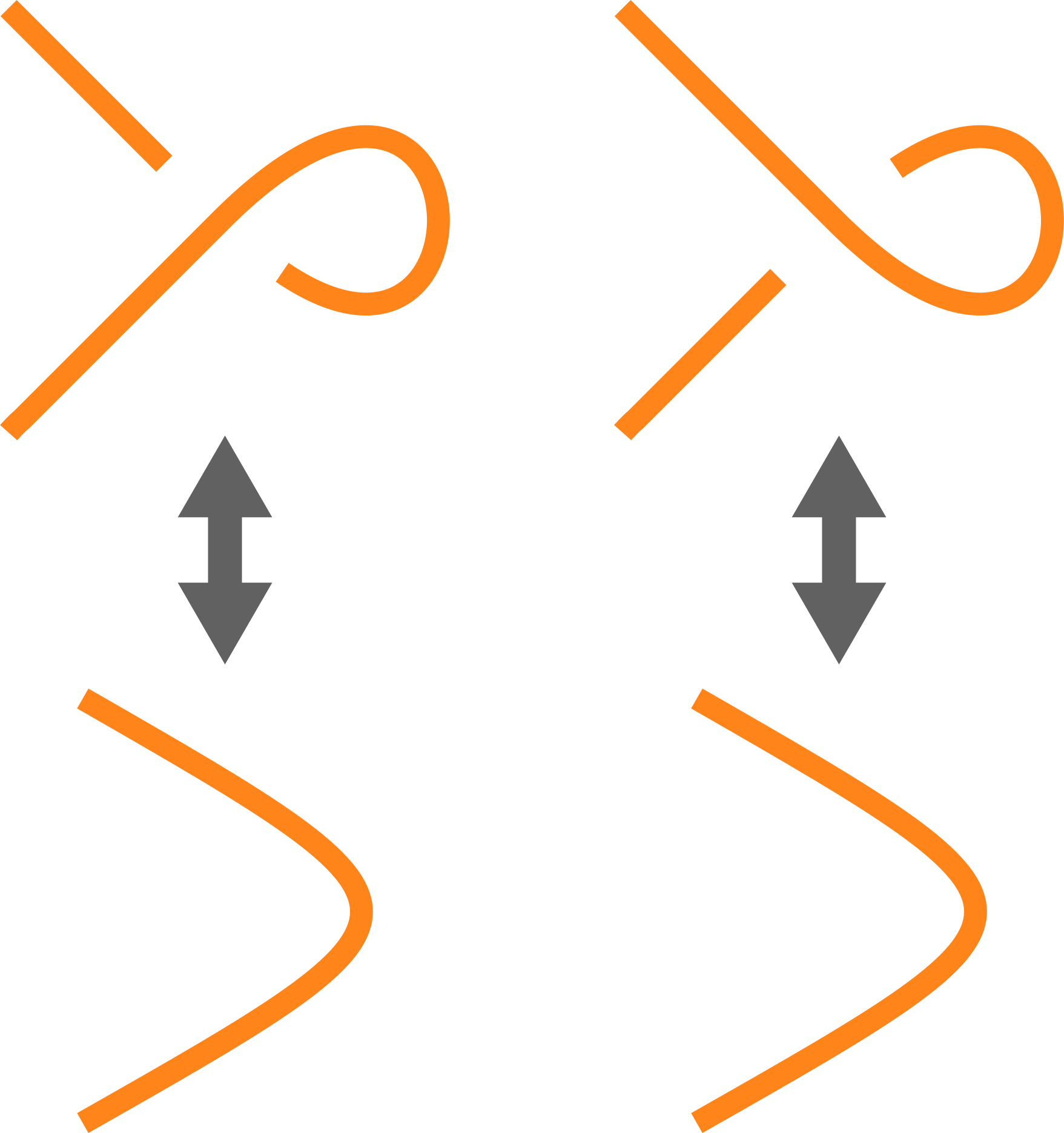
Figure 4:Executing the two flavors of type I move on a knot diagram. On the left, we have a twist into the plane, also called a positive or left-handed twist. On the right, we have a twist into the plane, also called a negative or right-handed twist.
The next Reidemeister move is the Type II move20, seen in Figure 5. When we carry out the type II move, we need two strands, each with no crossings. We then pull one strand on top of the other, inducing two new crossings in our diagram. Similarly to the type I move, the type II move can be freely undone by pulling the strands apart.
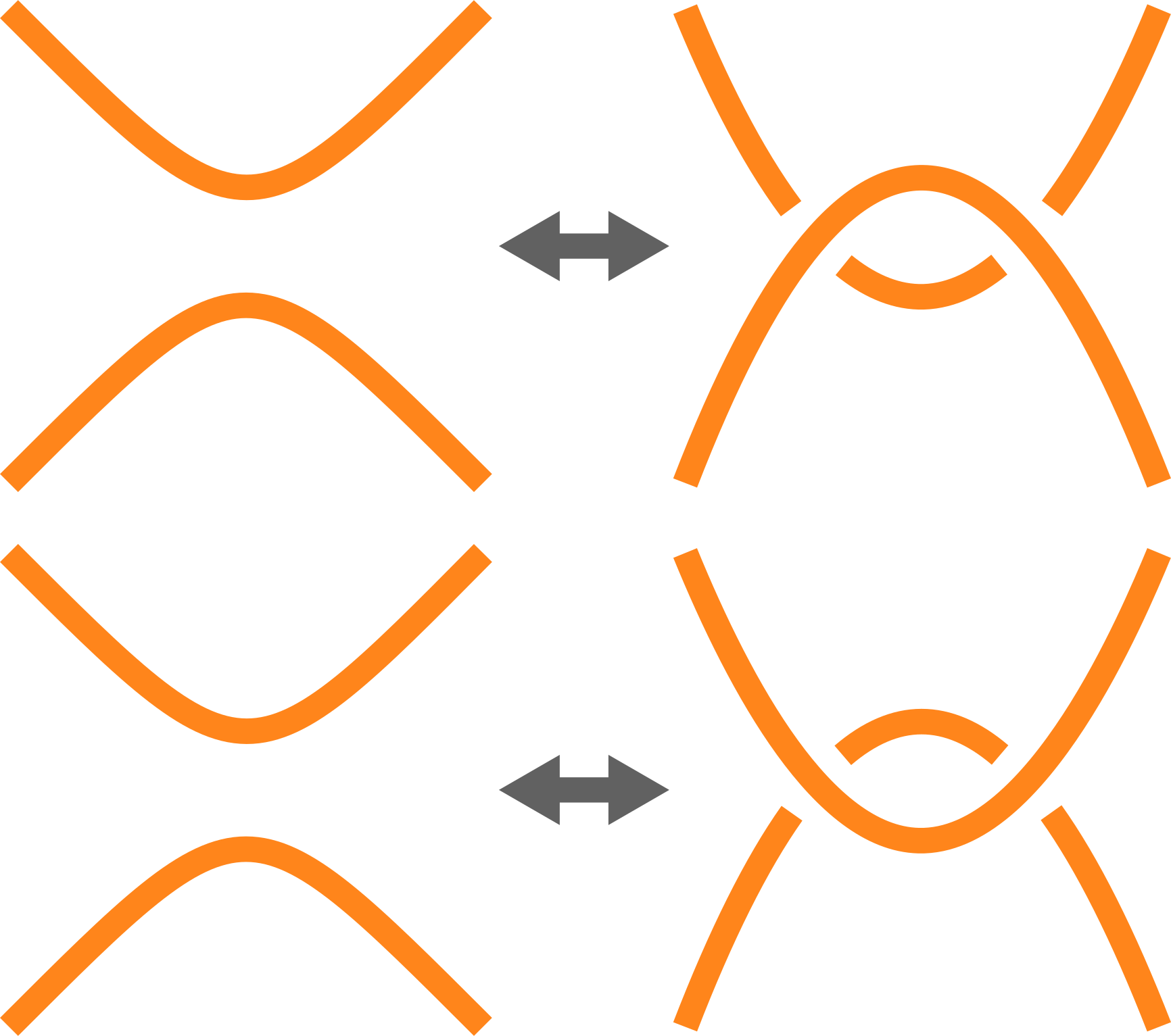
Figure 5:Executing the two type II moves with a pair of strands. In the top image, the bottom strand is pulled over the upper. In the bottom image, the bottom strand is pulled under the top strand.
The final Reidemeister move is the Type III move20. In the type III move, we take three strands, two that form a crossing and a third that lies in one of three possible positions:
above the over strand
between the over and under strands
below the under strand
We now execute the type III by taking the third strand (not part of the center crossing) and passing it across the center crossing. As with type I and type II, we’re free to reverse the type III move.
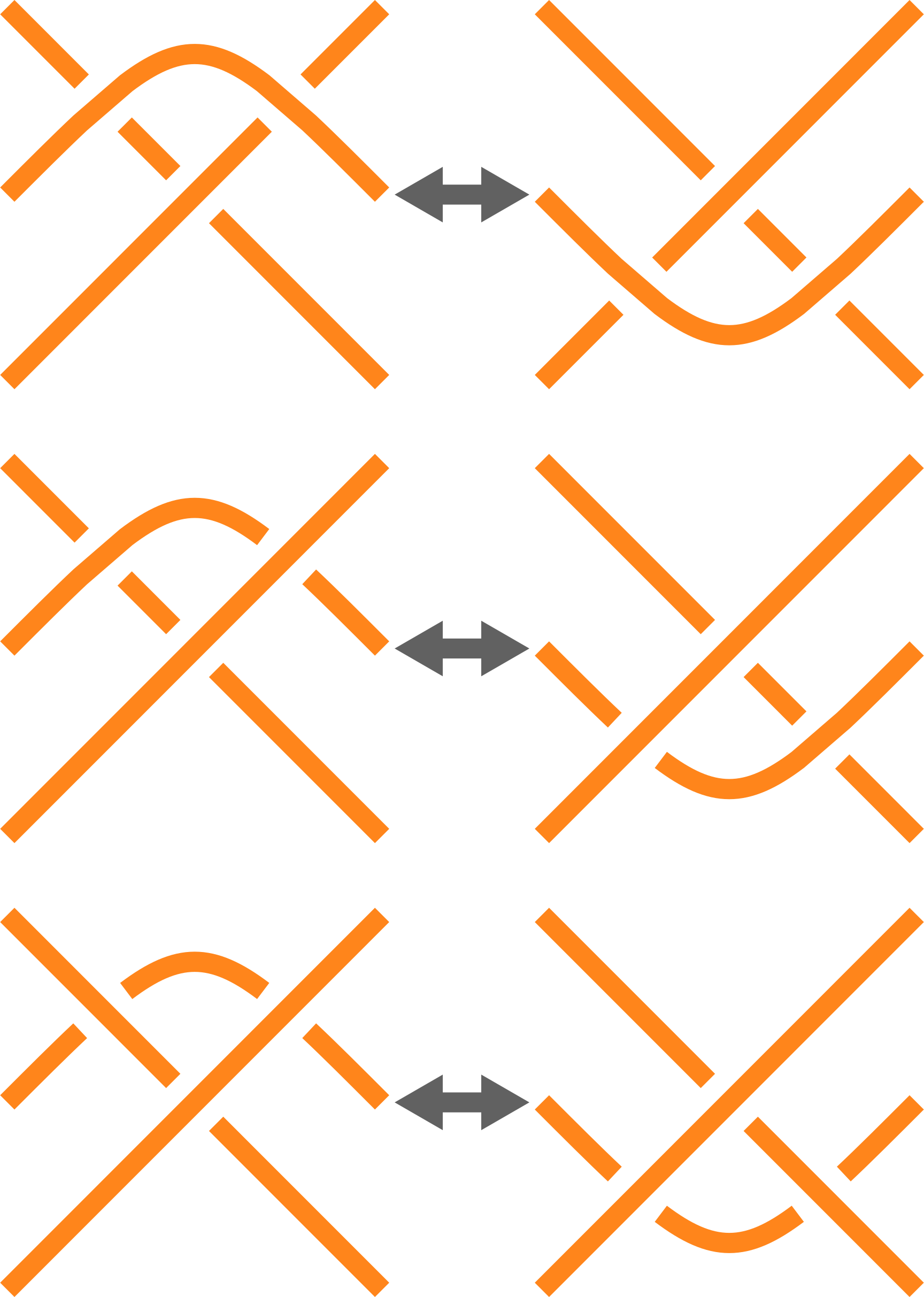
Figure 6:Executing the three type III moves with a set of three strands. Top to bottom, the third strand is:
on top of the crossing strands
between the crossing strands
under the crossing strands.
We should note here that with a concept of equivalence comes equivalence classes of knot diagrams. Historically, of particular interest in the tabulation of knots are the knot diagrams that have minimal crossing number; we call these minimal diagrams.
5.2.3Prime Knots
With the goal of enumerating objects, we should be clear on what types of objects should be enumerated and which should be left uncounted. We now describe the class of knot that tabulators are interested in, the prime knots. The first step is to define an operation on knots called the connect sum.
With the connect sum operation defined, we are now prepared to give the definitions for prime and composite knots.
5.2.4Knot Invariants
Our next topic of interest is that of a knot invariant. In general, an invariant for an object is a datum that is computed deterministically for the object and remains unchanged within an equivalence class. In the knot case, we will take the concept of equality to be that given in Section 5.2.2. As discussed in Section 5.1, invariants play an important role in computer tabulation. We will now describe a simple invariant we first introduced in Section 5.2.2.
5.2.4.1Minimal Crossing Number
We saw at the end of Section 5.2.2 the definition of the minimal crossing number for a knot. That being the minimal number of crossings needed to represent the knot as a diagram. Somewhat intuitively, this number is an invariant for a knot. If a knot has minimal crossing number 4, we will never be able to represent it with three crossings, so it has to be different from the trefoil knot (a knot with three crossings). However, we can see from the table of the first seven knots (seen in Figure 1) that having equivalent crossing number does not give us equivalent knots.
5.2.5Knot Notations
The final topic to cover in our treatment of foundations for knot theory is notational strategies for knots. In Section 5.2.1, we came across our first notational strategy for knots, the knot diagrams. While diagrams are a great human-readable way to note a knot, when the tasks of enumeration and computation (by hand) are considered, knot diagrams quickly show deficiencies. These deficiencies become intractable when a computer is brought into the picture. As a remedy for this issue, knot theorists have invented several combinatorial notations for knots. Perhaps the most historically important knot notation for use in tabulation by computer is the Dowker-Thistlethwaite (DT) notation developed by its namesakes specifically for use in computational tabulation. Each notational strategy used in knot theory has strengths and weaknesses. For example, using DT notation for computation of the Jones polynomial may be more cumbersome than using the Planar Diagram (PD) notation for the same task, as PD directly encodes crossings while DT encodes a walk on a strand. The remainder of this section will be the development of the Conway notation, which lays the foundation for the work in this thesis.
5.2.5.1Conway Notation
In Section 5.1, we saw that Conway claimed to have enumerated knots up to 11 crossings in “a few hours”. Conway accomplished this by breaking knots into building blocks he called tangles. This section gives an outline of the tools he developed and used to achieve those “few hours” of amazing efficiency.
Definition of a Tangle
Our first step in unlocking Conway’s tabulation secrets is the definition of a tangle. We will give Conway’s original definition followed by a description of what this looks like for a three dimensional embedding for a knot.
These boundaries that split knots at four points are called Conway circles, and we call the points boundary points. Formally, we can consider a Conway circle to be a Jordan curve [7] meeting the knot diagram in exactly four points 21. In general, we prefer our Conway circles to actually be circles in the colloquial sense. Luckily, the circle and Jordan curve constructions are equivalent. This can be seen by a straightforward isotopy of one into the other, Figure 8.
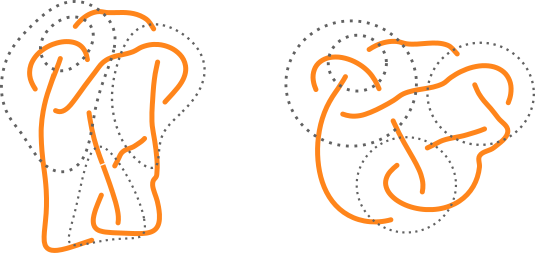
Figure 8:An isotopy turning Jordan curves into circles.
We move our attention to the three dimensional analog for a Conway circle, the Conway sphere. A Conway sphere, similar to the Conway circle, is an that encapsulates a portion of a knot so that the knot intersects the sphere in exactly four points. Here we see the first example of our preference for ambient space to be as opposed to . When a knot in is split by a Conway sphere, the ambient is decomposed into two , each with a portion of the knot. Meaning, a single Conway sphere splits a knot into a pair of tangles.
Basic Tangles
Often, when thinking about a new construction, we focus on the simplest object that can be created with the construction. In the case of drawing Conway circles to build tangles, the simplest tangles are a tangle with no crossings (the 0 tangle Figure 9a) and a tangle with a single crossing (the +1 tangle Figure 9b).
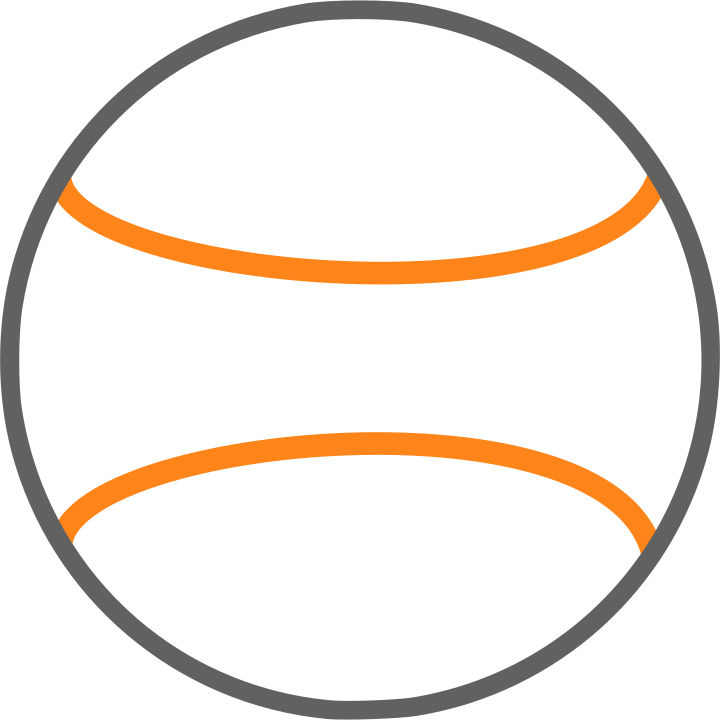
(a)A tangle with no crossings, called the 0 tangle.
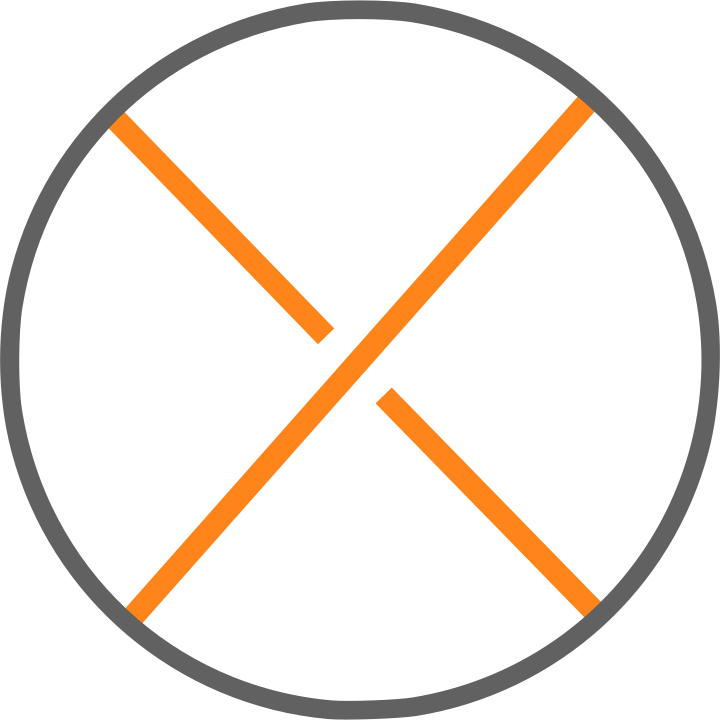
(b)A tangle with a single crossing, called the 1 tangle.
Figure 9:Two basic tangles.
Rotation and Mirroring of Tangles
Consider a generic tangle, as seen in Figure 10, where orientation (the position of the NW point) of data in the interior of the Conway circle is indicated by a broken .
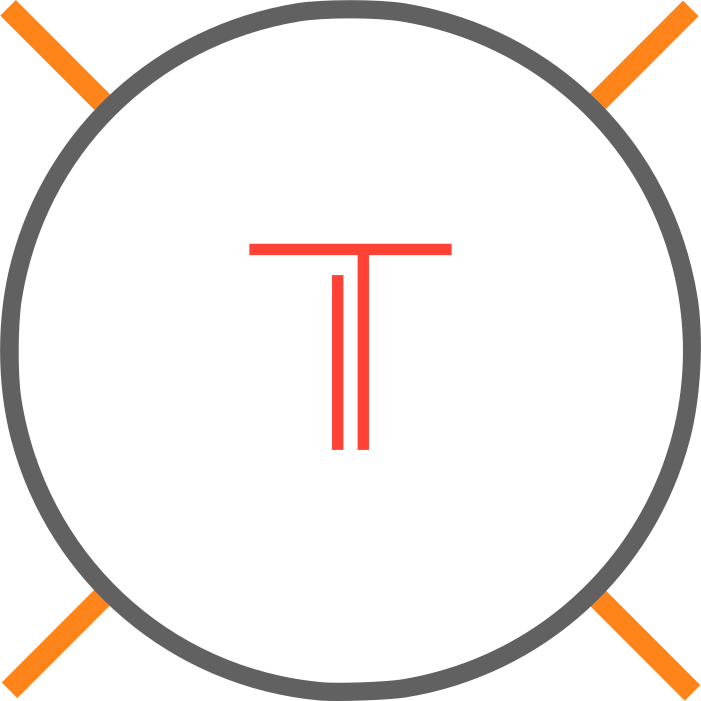
Figure 10:A generic tangle with a broken T.
We can manipulate this tangle by the set of rotations, clockwise or anti-clockwise. Each rotation in turn gives a new arrangement of the interior data. We can also manipulate the tangle by the set of flips, one around the core x-axis and one around the y-axis. Each flip gives an arrangement of the interior data. Pairing flips with rotations gives the table seen in Figure 11.
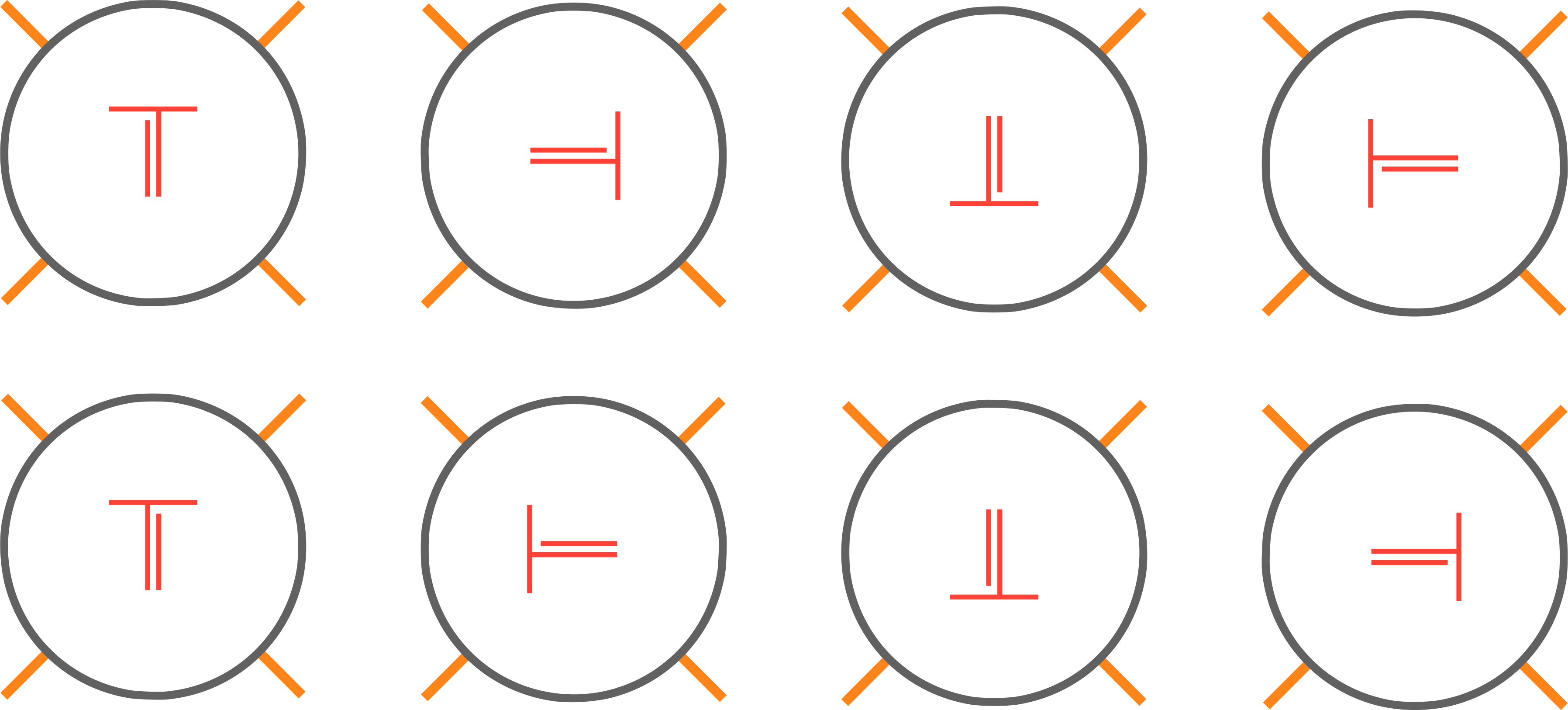
Figure 11:A table with all unique rotations and flips for a generic tangle. From top to bottom in the first column: No Flip Flip around the north south axis. From left to right in each row: No rotation rotation quarter turn clockwise rotation half turn clockwise rotation three quarter turn clockwise rotation quarter turn clockwise
When we apply this set of flips and rotations to the basic tangles seen in Basic Tangles, we obtain the two additional basic tangles seen in Figure 12.
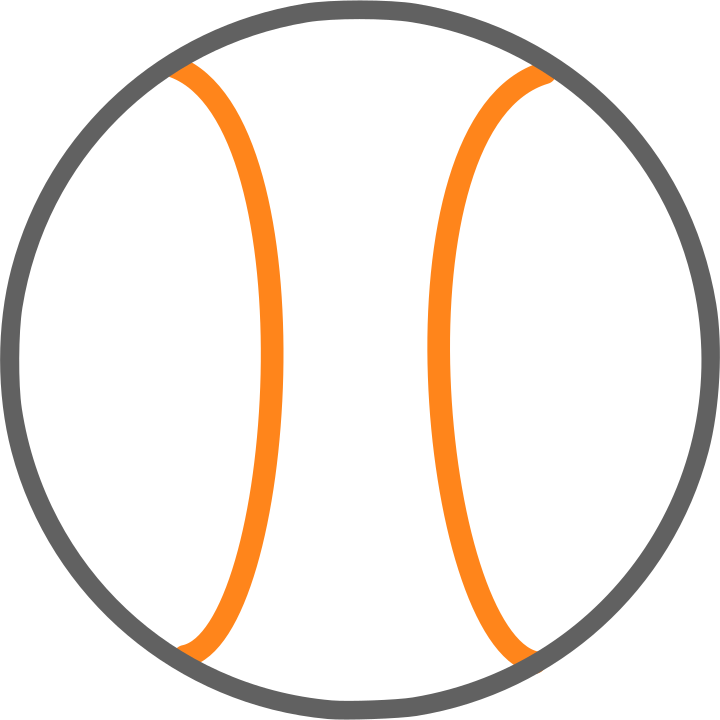
(a)A tangle with no crossings, called the tangle.
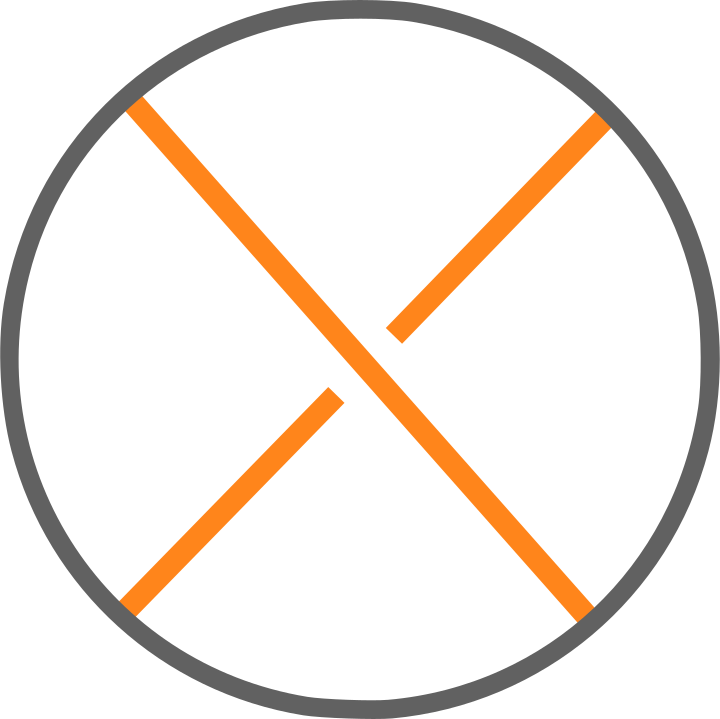
(b)A tangle with a single crossing, called the tangle.
Figure 12:Two additional basic tangles.
Operations on Tangles
In addition to the rotations and flips, Conway introduced a calculus on tangles 8. This calculus allowed Conway to build the simple basic tangles into iteratively more complex tangles.
Minus Tangle
For a generic tangle , we call the tangle generated from a clockwise rotation and flip around the y-axis the negative of , notated . Equivalently, this can be thought of as rotating the tangle around the and axis (Figure 13).
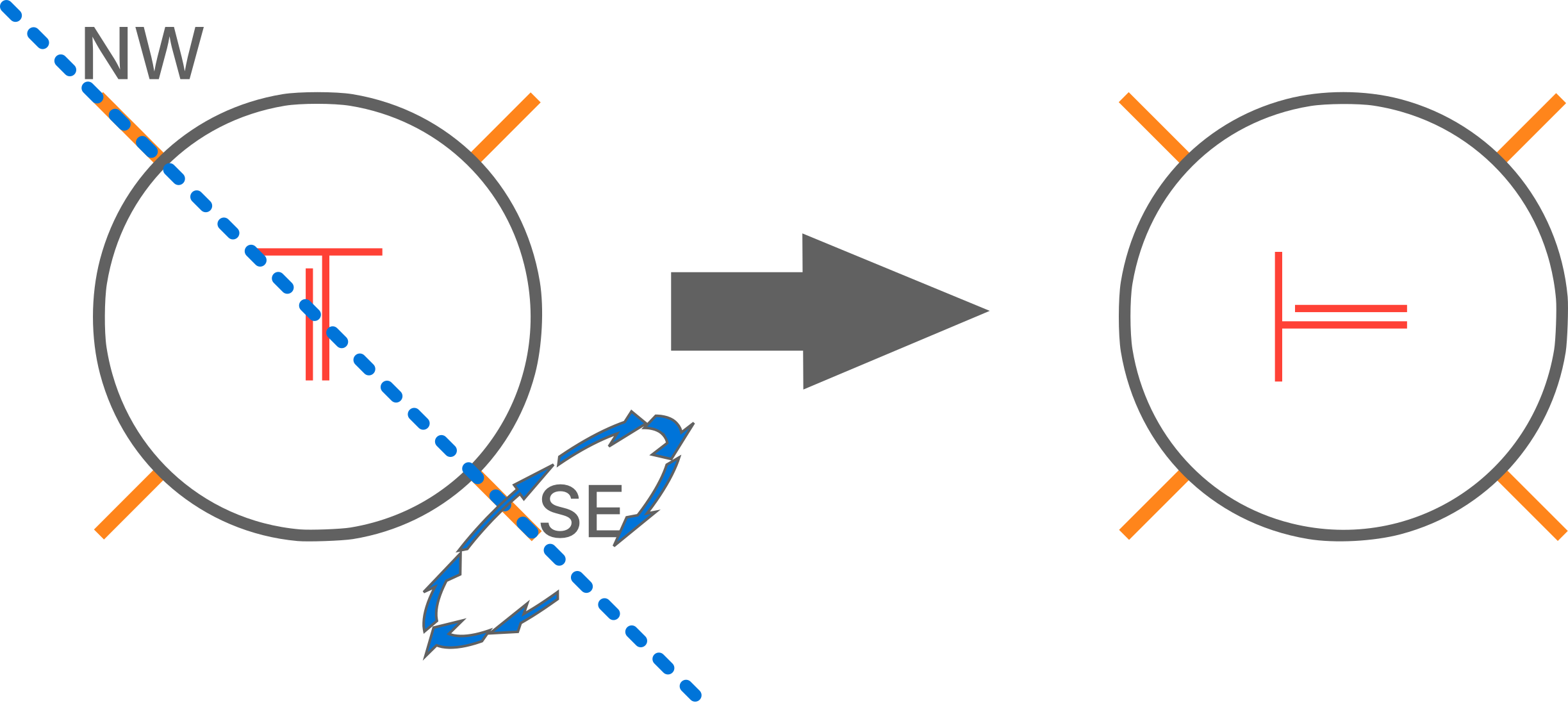
Figure 13:Rotating a tangle around the diagonal, yielding the negative of the tangle.
Tangle Addition
For a pair of generic tangles, and , we construct their sum by first aligning and horizontally. We then connect the and of to the and of , as seen in Figure 14.
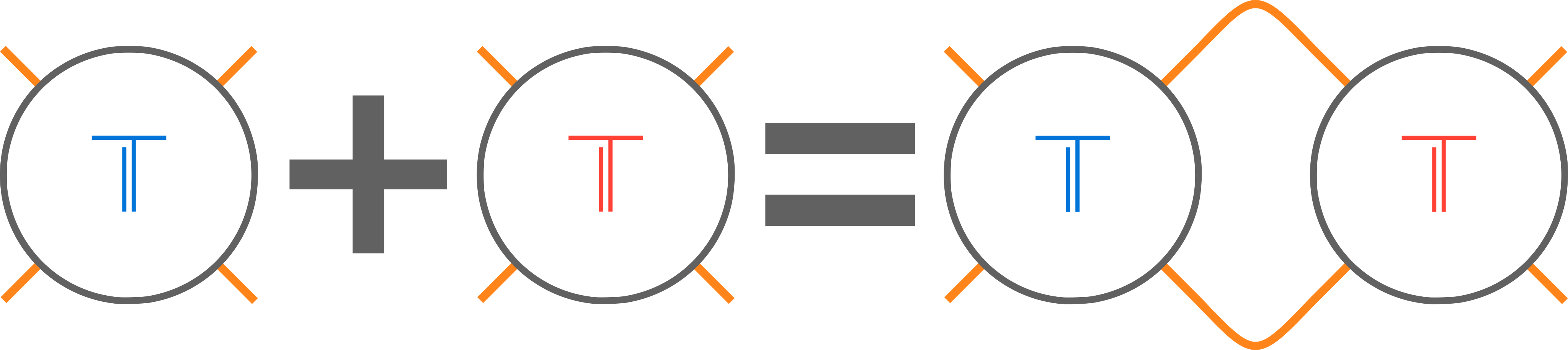
Figure 14:The sum of two generic tangles.
The class of tangles built by successive addition of the basic tangles are called the integral tangles.
Tangle Multiplication
For a pair of generic tangles, and , we construct their product, (or ) by first aligning and horizontally. We then take and sum the two resulting tangles, equivalent to , as seen in Figure 15.
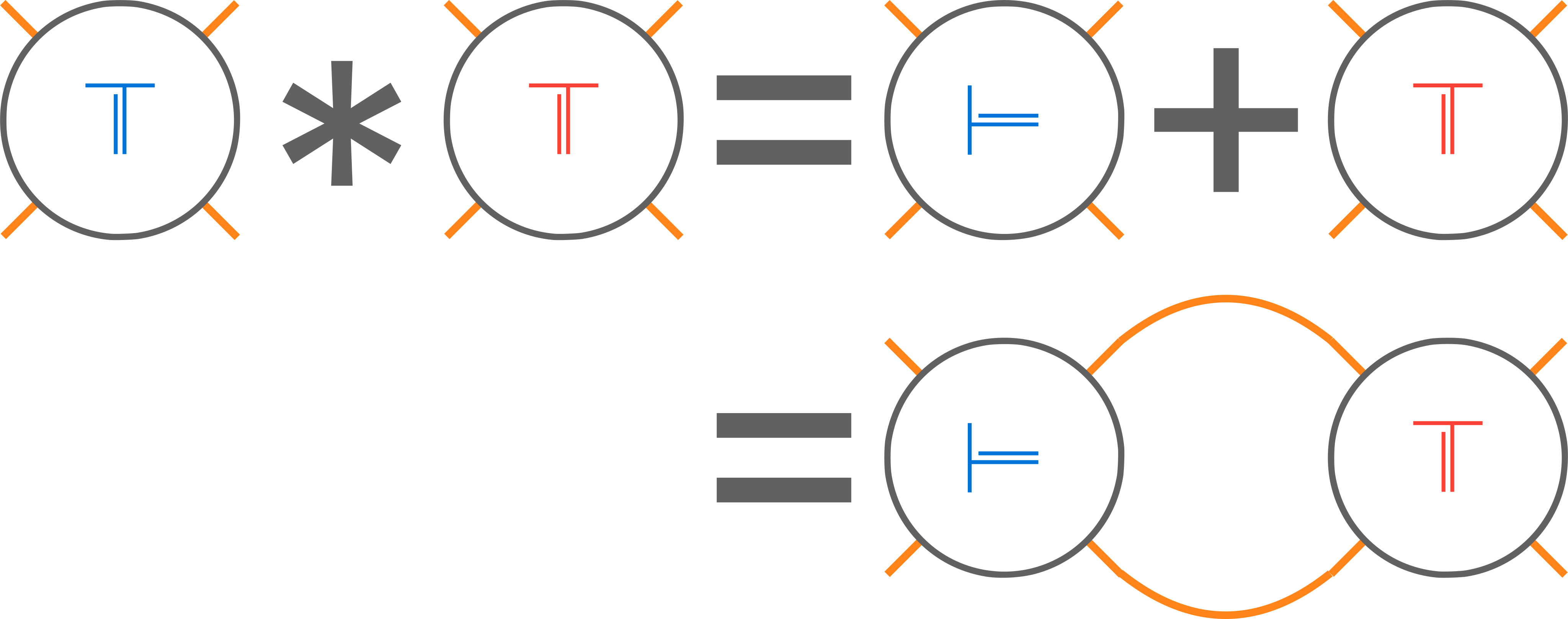
Figure 15:The product of two generic tangles
Tangle Ramification
For a pair of generic tangles, and , we construct their ramification by first aligning and horizontally. We then take and and sum the resulting tangles. This makes ramification equivalent to or , as seen in Figure 16.
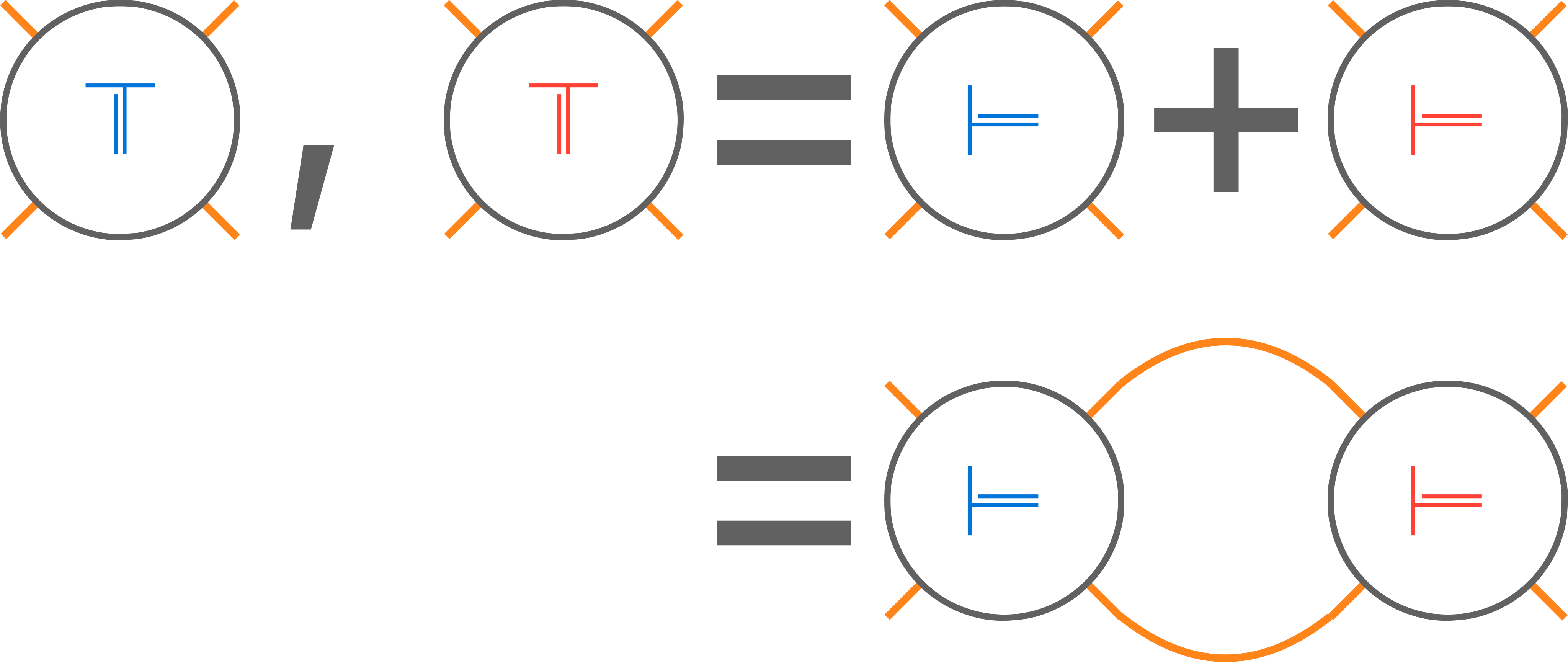
Figure 16:The ramification of two generic tangles.
Indicating Precedence
With a set of operations comes the desire to chain multiple operations together. The precedence for operations on tangles is indicated by parentheses in the obvious way (Figure 17).
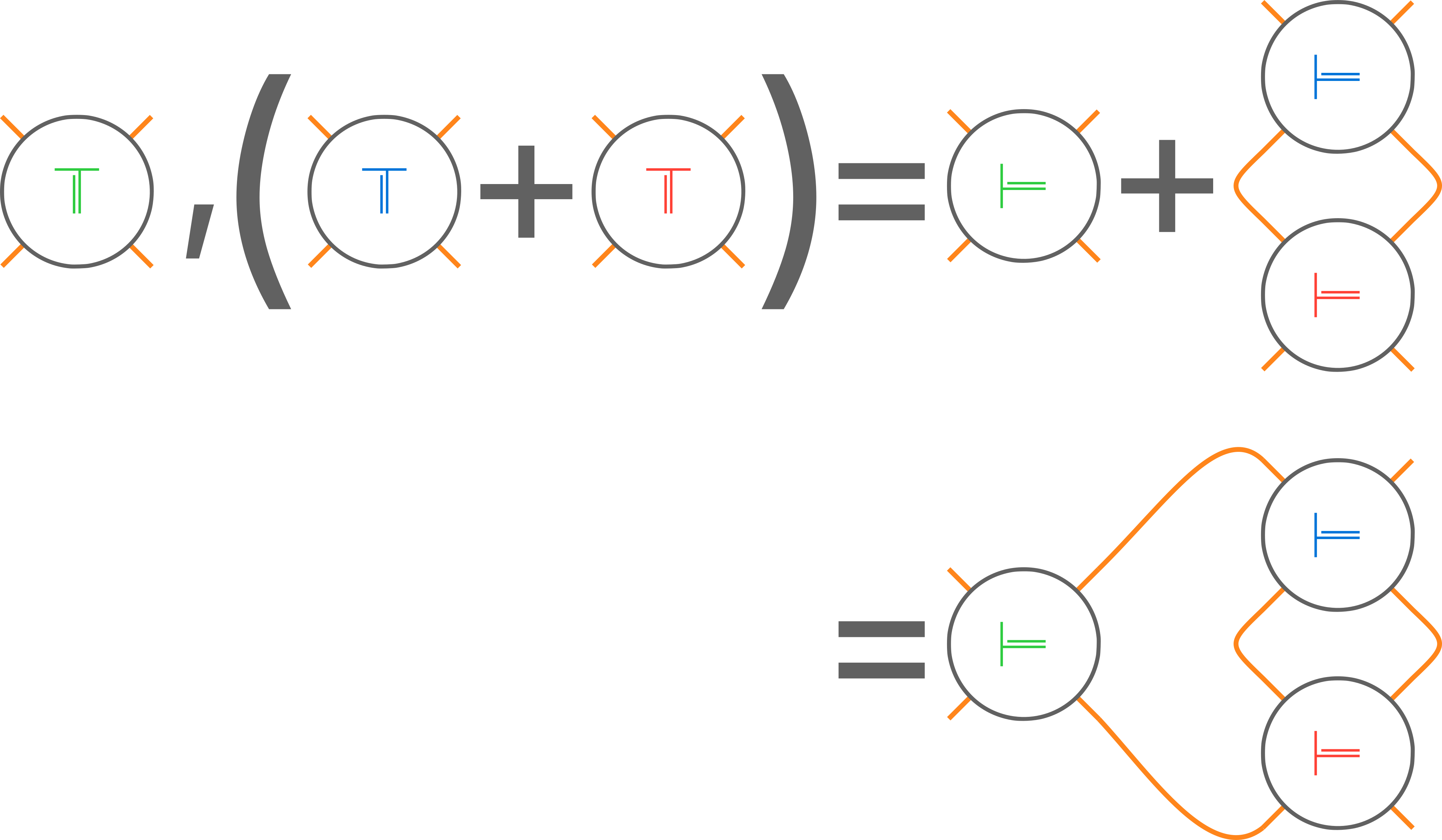
Figure 17:Multiple operations chained together with precedence indicated by parentheses.
The Flype
When working in this calculus of tangles, a common situation you find yourself in is one where the 1 (or ) tangle is added to a tangle. In this situation, we can move the 1 crossing from one side of to the other by a flype. To complete a flype, we grab the top (north) and bottom (south) of the tangle and rotate (opposite the handedness of the crossing) as in Figure 18.
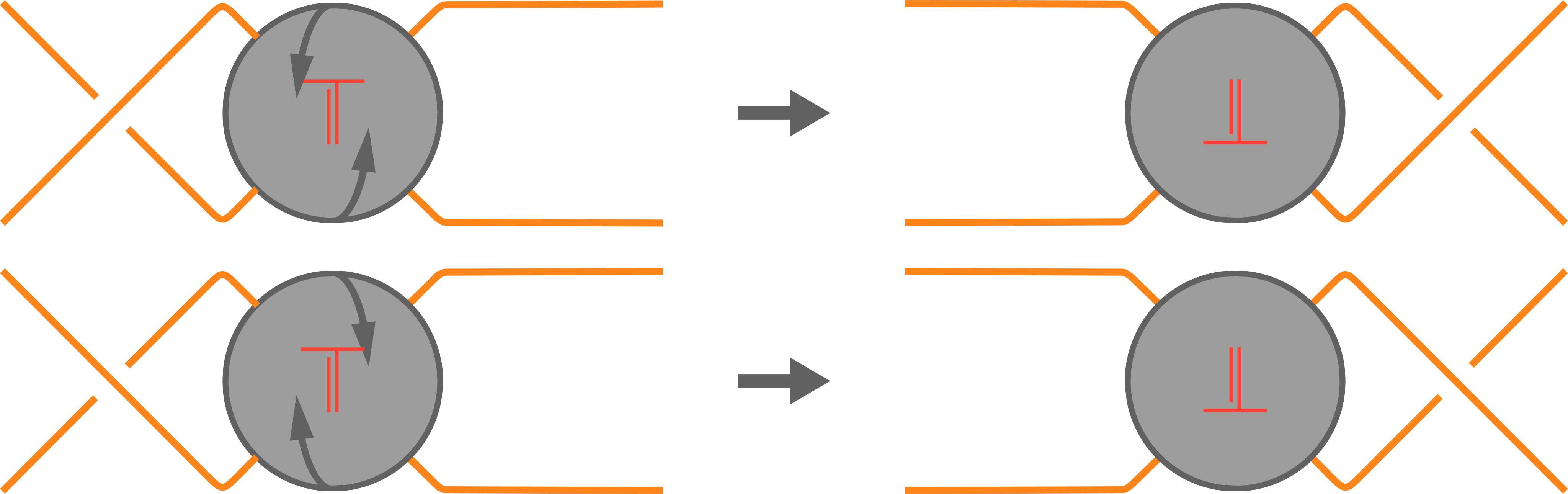
Figure 18:A -flype on the top and a -flype on the bottom. Note that the generic tangle is flipped around the -axis during the flype.
Closures
Since Conway’s interest was in knots, he naturally needed ways to close up a tangle to form a knot. In this section, we will introduce two ways that this can be accomplished. The first closure method is the simple tangle closure, where points on a tangle are connected. The second closure method is the insertion of multiple tangles into a graph.
Simple Tangle Closures
The first closure method is the simple tangle closure. For a generic tangle , we have two options for how to simply close up the tangle. One option is to connect a strand from to and a strand from to (Figure 19a), called the numerator closure. The alternative is the denominator closure, formed by connecting a strand from to and a strand from to (Figure 19b). In both cases, we introduce no additional crossings.
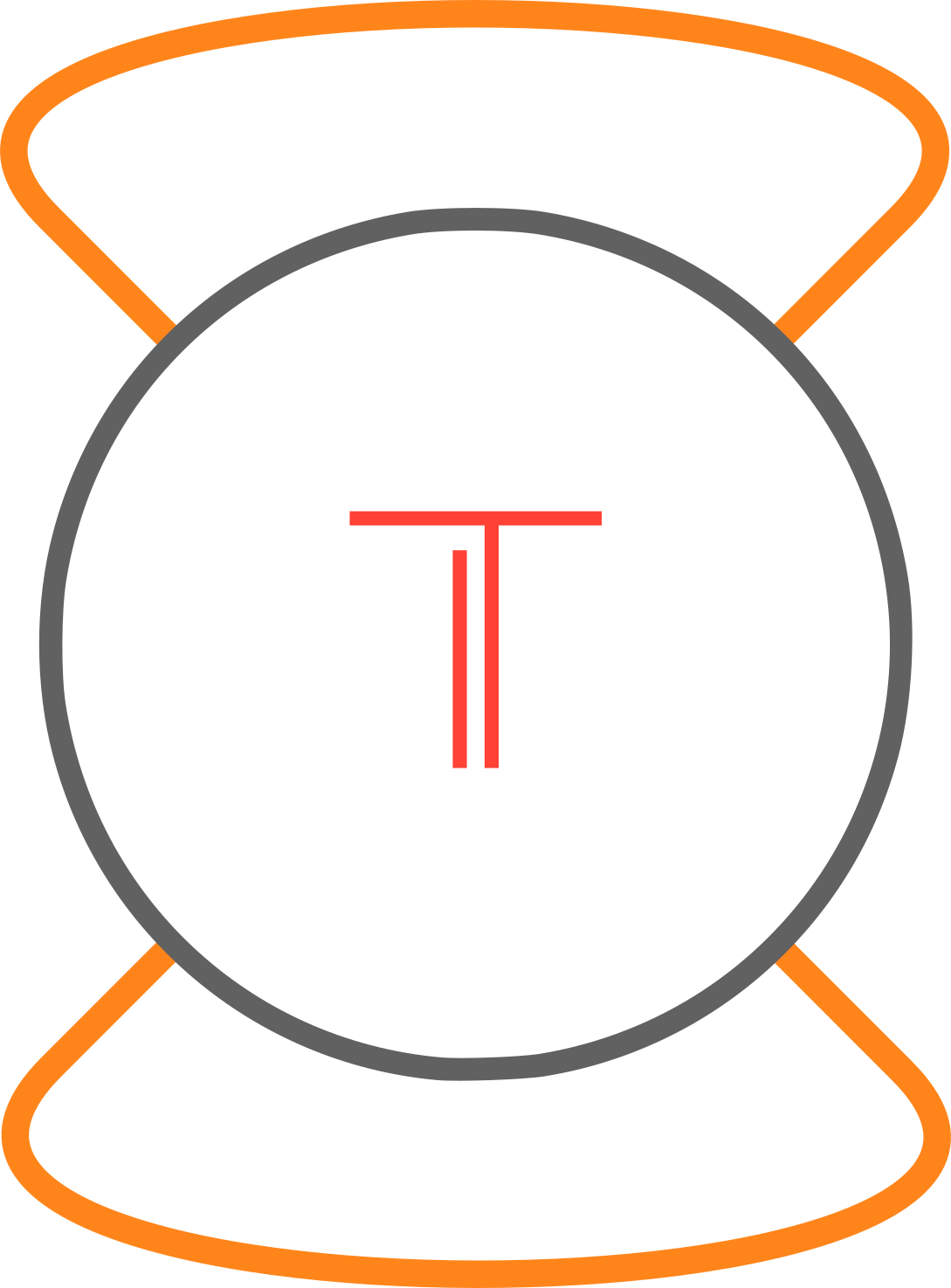
(a)The numerator closure of a tangle.
(b)The denominator closure of a tangle.
Figure 19:The two simple closures of a tangle.
Tangle insertions
With the calculus of tangles and simple closures, Conway was able to enumerate a substantial number of knots, but not all. We should notice a common theme with the calculus, when starting with basic tangles every operation forms a bigon[8]. We can collapse bigons in the knot shadow by deleting edges and merging the two vertices of a bigon. For a knot formed by only the operations and simple closures, if we iteratively collapse all bigons we obtain a four-valent planar graph [9] with one vertex, per Figure 20. The class of knots who have a presentation where bigons can be collapsed to a single vertex with two self edges are called the algebraic knots.
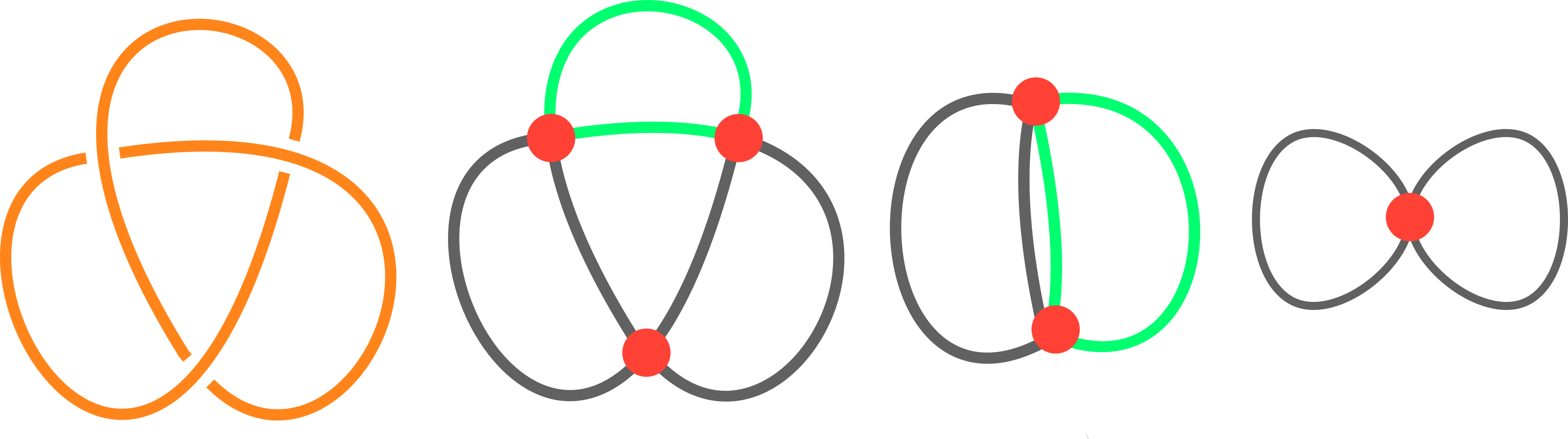
Figure 20:The collapsing of the bigons in a knot shadow from left to right: A trefoil knot. A knot shadow for a trefoil knot with a bigon highlighted. The previously highlighted bigon collapsed, and a new bigon highlighted. A graph with no bigons.
To obtain a knot that has non-bigon connections between inputs, we will first identify a four-valent planar graph that has non-bigon connections between vertices. The class of graph that is most useful here are the polygon graphs. For example, the graph (or octahedron) can be seen in Figure 21. Within the graph, we notice triangular regions between vertices.
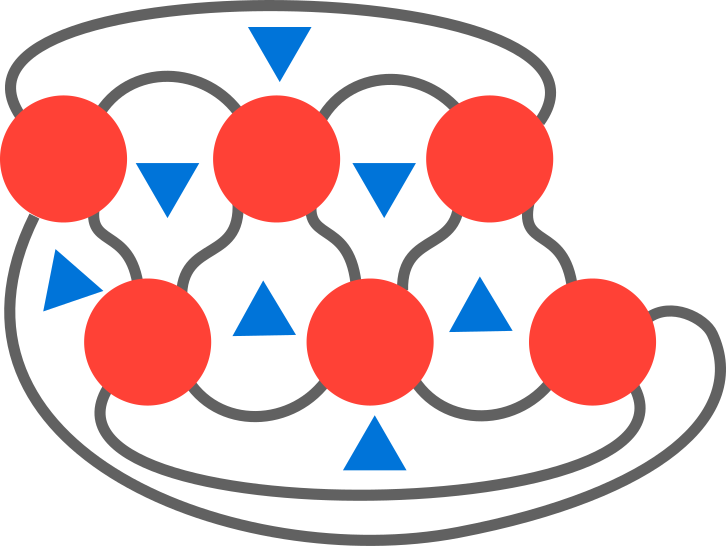
Figure 21:A four valent planar graph with six vertices and triangular regions between vertices. When the graph is placed on the surface of an we get the octahedron.
The simplest thing we can do from here is consider the graph as a knot shadow, and for each vertex, choose an over and under strand. While that method would give us a knot, it is limiting. Less limiting is a process of tangle insertion. In this process we consider each vertex a boundary of a Conway circle in which we can place a tangle generated with the Conway calculus. When we insert the tangle into the Conway circle (vertex in the graph), the points of the tangle are connected to marked points of the Conway circle (the four edges of the vertex). An example of a tangle insertion into can be seen in Figure 22.
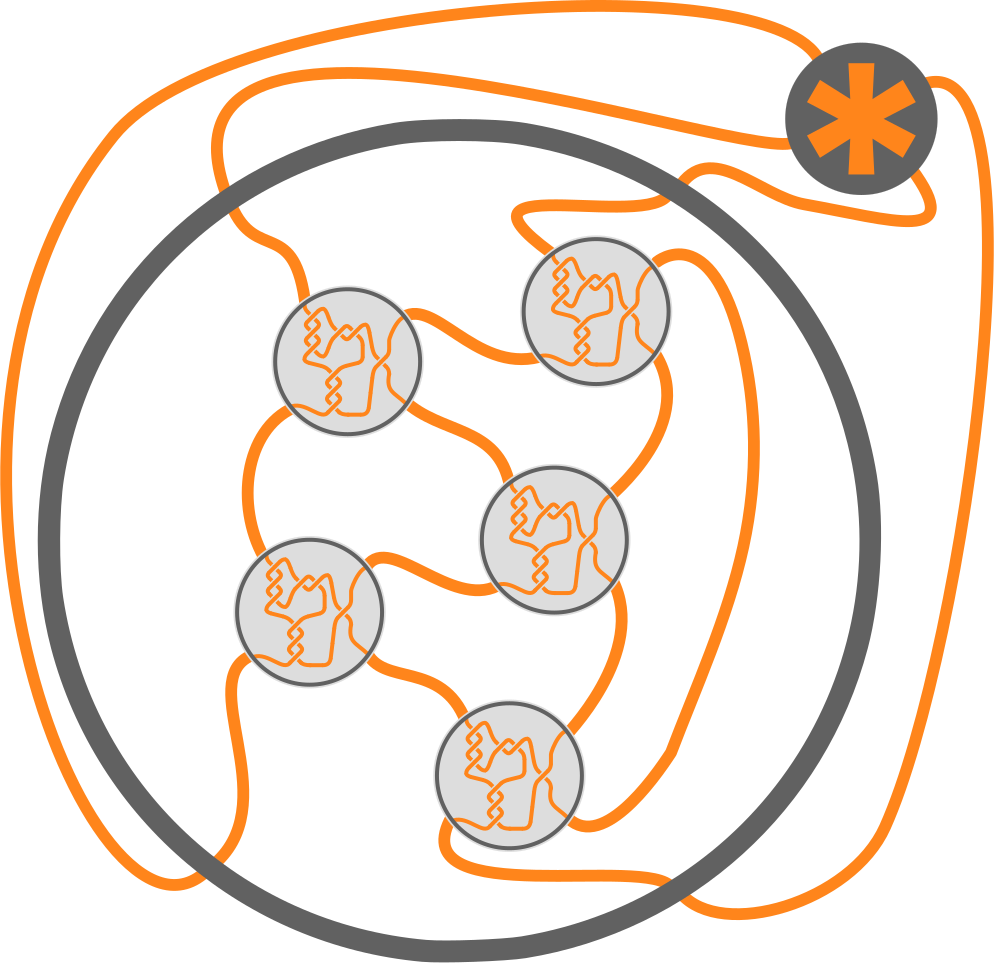
Figure 22:Tangles inserted into the tangle, with Conway notation
The labeled vertex defines the four boundary points of the resulting tangle.
When each vertex has a tangle inserted, the result is a knot. When vertices are left empty, the result is a tangle with boundary Conway circles. If is 1, we have a tangle in the sense we’ve been discussing. To reduce ambiguity, we mark in the graph with a in that empty vertex. On each polygon graph, we select a canonical ordering of the vertices, per Figure 23. When notating the tangle insertions, we list the subtangles we wish to insert in graph canonical order, each separated by a period and an empty vertex indicated with . Following the terminology outlined by Conolly 15, we call these singularly marked polygonal graphs constellations. We call the tangle diagrams generated by this approach the polygonal diagrams. If a tangle has no algebraic representative we call it a polygonal tangle.
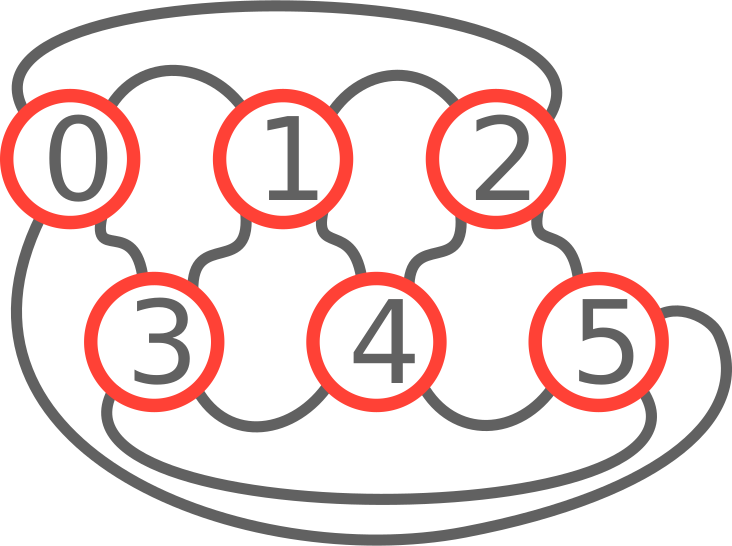
Figure 23:The graph with an order applied.
5.3Foundations of Tangles
So far we have used tangles as a building block for knots, we will switch gears slightly to consider a tangle as our main object of interest. This section will give the foundations of the theory of tangles needed for the remainder of this thesis.
5.3.1Tangle Equivalence
As we saw for knots in Section 5.2.2, if we want to tell two tangles apart, we first need to be able to identify when tangles are the same. Our development of the concept of equality of tangles follows closely that of knots. From Definition of a Tangle, we have definitions for tangles in the context of knot diagrams and three-dimensional embeddings of knots. This tells us that the concepts of equality developed in Section 5.2.2, namely ambient isotopy and Reidemeister moves, will apply in the tangle case with two key differences.
The first difference with tangles when compared to knots is that we restrict ambient isotopy and Reidemeister moves from pushing a strand through the Conway sphere (Conway circle). The second difference is the handling of the boundary points. There are two conventions for how to handle equality with the boundary points; first allowing the boundary points to move on the Conway sphere, and second fixing the boundary points on the Conway sphere.
5.3.1.1Moveable Boundary Points
Our first case for handling the boundary of a tangle is allowing the boundary points to move freely on the Conway sphere. In this case, a generic tangle is equivalent to each of its rotations and flips (Rotation and Mirroring of Tangles). In addition to the rotation and flip equivalence, a moveable boundary allows us to unwind the outermost integral components of a tangle (Figure 24).
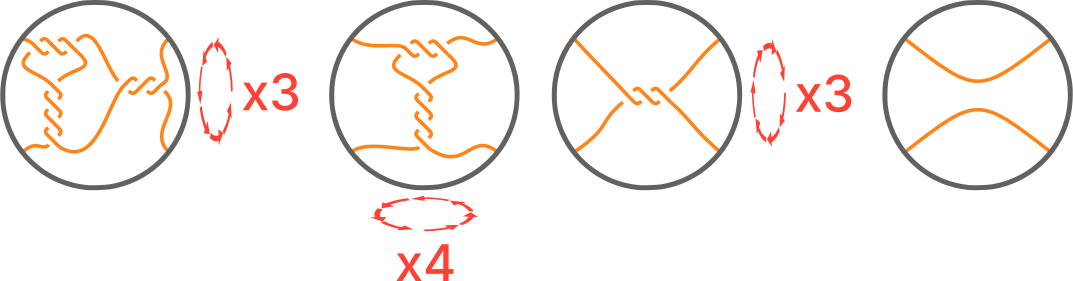
Figure 24:The progressive unwinding of integral tangles, leaving a basic 0 tangle.
For this thesis, we will assume tangles have a fixed boundary unless explicitly mentioned.
5.3.1.2Non-moveable Boundary Points
The non-moveable case is the more straightforward of the two boundary concepts of equality for tangles. In the fixed boundary world, we have four distinct basic tangles seen in Figure 9 and Figure 12. These are all distinct when the boundary is fixed. In Figure 25 we find two tangles, each with two crossings but not equivalent by Reidemeister moves.

(a)A horizontal integral tangle with two crossings.

(b)A vertical integral tangle with two crossings.
Figure 25:Two nonequivalent tangles with two crossings.
5.3.2Modified Tangle Operations
In Operations on Tangles we saw Conway’s calculus of tangles. While this construction is powerful and flexible, it’s rather unintuitive and cumbersome when combined with computer methods. In this section, we will describe a slightly modified, but equivalent, version of the calculus. This version of tangle arithmetic is due to Kauffman and Goldman 22.
Instead of Conway’s three operations on the two basic tangles 1 and 0, this arithmetic needs the two basic operations and all four basic tangles (Figure 9 and Figure 12). The first operation in this arithmetic is exactly Conway’s horizontal sum, (Figure 14). The second operation is the vertical sum, , sometimes written 22 or 23. For generic tangle and , is built analogously to the but stacking vertically on top of instead of horizontally (Figure 26).
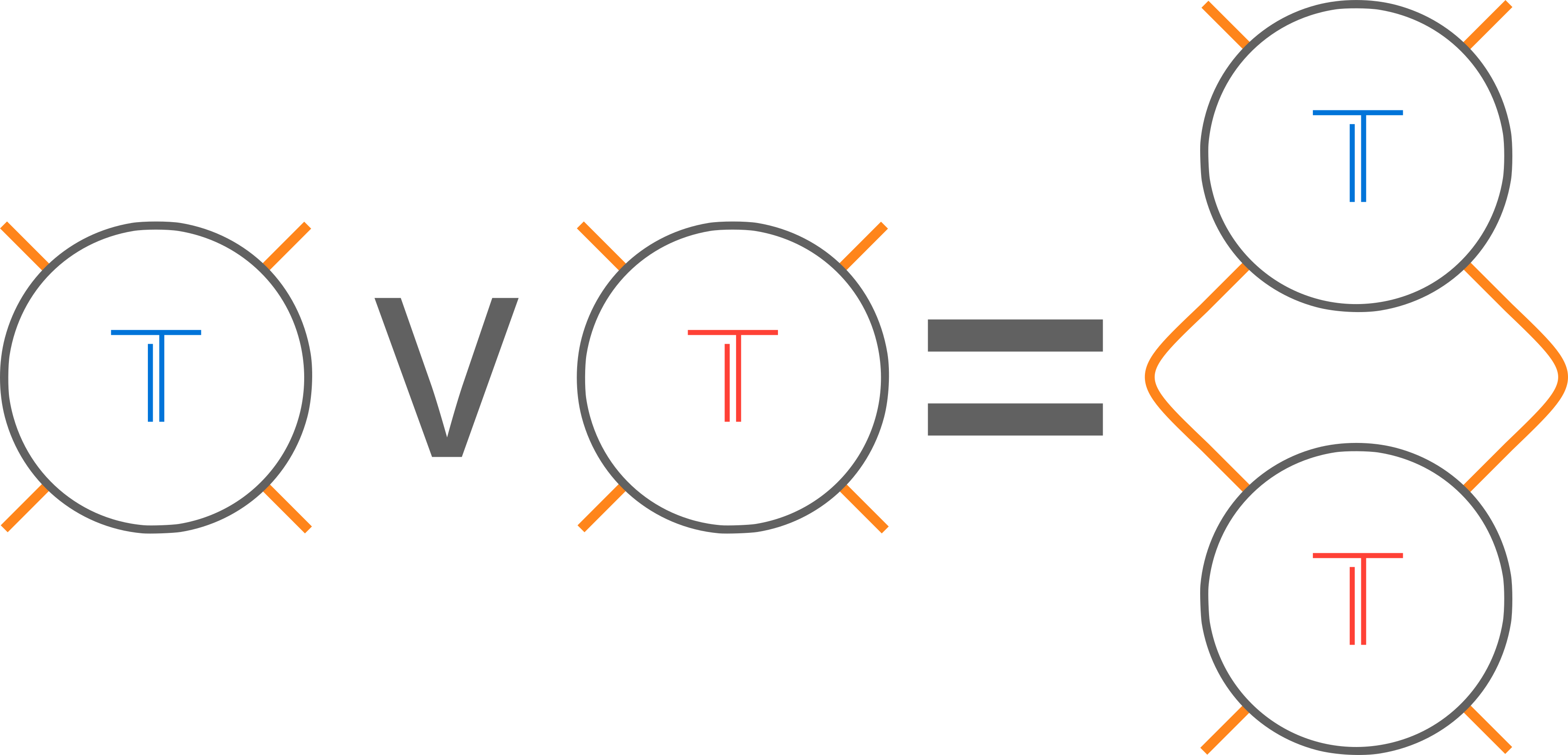
Figure 26:The vertical sum of two generic tangles.
These two operations combined with parentheses as in Indicating Precedence give a natural arithmetic structure to the combinations of tangles. We’ll see in later sections how this structure is easily encoded on a computer as a data structure. We conclude the section by redefining the algebraic tangles.
5.3.3Integral Tangles
We finish the chapter with a description of a class of tangles we first encountered in Tangle Addition. The integral tangles are the simplest class of tangle that are built from the basic operations on basic tangles. We start by defining the horizontal integral tangles.
It is convenient to notate the horizontal integral tangles simply by their corresponding integer, . A similar construction can be defined for the operation, yielding the vertical integral tangles.
We will notate the vertical tangles by .
In software development, the mathematical concept of an equivalence class is often called a ``bin’'.
Short for deduplicating, meaning the removal of duplicate entries from the list.
When discussing algorithms, a heuristic describes a special case that, when seen, short circuits the algorithm, reducing unnecessary work.
The real effective time of a clock on a wall, this is different from CPU time which is a relative measure of time.
An aggregation of many computers, each with many computational cores. We’ll see later in this thesis that tabulation is massively parallelizable.
A graph in the mathematical sense, a set of vertices combined with a set of relationships between those vertices called edges. A planar graph is a graph that when drawn in the plane has no overlapping edges.
A Jordan curve is a simple closed curve. This can be thought of as a curve drawn on a piece of paper that has: 1) No end points. 2) No self intersections.
A bigon is a polygon with two sides. In the same way that an octagon has eight sides or a trigon (triangle) has three.
- Thomson, W. (1867). On Vortex Atoms. Proceedings of the Royal Society of Edinburgh, VI, 94–105. https://zapatopi.net/kelvin/papers/on_vortex_atoms.html
- Tait, P. G. (1884). The First Seven Orders of Knottiness. Transactions of the Royal Society of Edinburgh, 32, 44.
- Scharein, R. G. (1998). Interactive Topological Drawing.
- Tait, P. G. (1885). Tenfold Knottiness. Transactions of the Royal Society of Edinburgh, 32, 80,81.
- Kirkman, T. (1885). The Enumeration, Description, and Construction of Knots of Fewer than 10 Crossings. Transactions of the Royal Society of Edinburgh, 32, 80–81.
- Little, C. N. (1885). On Knots, with a Census for Order 10. Transactions of the Connecticut Academy Sciences, 7(18), 27–43.
- Perko, K. A. (1974). On the Classification of Knots. Proceedings of the American Mathematical Society, 45(2), 262–266. 10.1090/S0002-9939-1974-0353294-X
- Conway, J. H. (1970). An Enumeration of Knots and Links, and Some of Their Algebraic Properties. Computational Problems in Abstract Algebra, 329–358. 10.1016/B978-0-08-012975-4.50034-5
- Caudron, A. (1982). Classification Des Noeuds et Des Enlacements. Université de Paris-Sud, Dép. de mathématique. https://books.google.com/books?id=W1nvAAAAMAAJ
- Dowker, C. H., & Thistlethwaite, M. B. (1983). Classification of Knot Projections. Topology and Its Applications, 16(1), 19–31. 10.1016/0166-8641(83)90004-4
- Hoste, J., Thistlethwaite, M., & Weeks, J. (1998). The First 1,701,936 Knots. The Mathematical Intelligencer, 20(4), 33–48. 10.1007/BF03025227
- Burton, B. A. (2020). The Next 350 Million Knots. LIPIcs, Volume 164, SoCG 2020, 164, 25:1-25:17. 10.4230/LIPICS.SOCG.2020.25
- Bar-Natan, D. (n.d.). The Most Important Missing Infrastructure Project in Knot Theory. https://katlas.math.toronto.edu/drorbn/AcademicPensieve/2012-01/one/The_Most_Important_Missing_Infrastructure_Project_in_Knot_Theory.pdf
- Kanenobu, T., Saito, H., & Satoh, S. (2003). Tangles with up to Seven Crossings. Interdisciplinary Information Sciences, 9(1), 127–140. 10.4036/iis.2003.127
- Connolly, N. (2021). Classification and Tabulation of 2-String Tangles: The Astronomy of Subtangle Decompositions. University of Iowa. 10.17077/etd.005978