In this chapter, we describe the future research directions for the tabulation of tangles. The future directions take two forms. First, the direct next steps to the work of this thesis (Section 8.1). Second, an undergraduate research research experience program with a collection of undergraduate problems (Section 8.2).
8.1Continued Tabulation
In this section, we describe the next steps for what has been discussed in Chapter 6 Tabulation. The first item to tackle in our future tabulation work is the reconciliation of our table of arborescent tangles with the algebraic table produced by Gren, Sulkowska, and Gabrovšek 1. Following this our efforts take two forms, first a collection of minimalization problems for the data we have generated. Second, is the expansion of this work to cover the complete set of two string tangles, the arborescent and the polygonal.
8.1.1Minimalization of Arborescent Tangles
As we discussed in Section 6.2.2.5, that RLITT are often non-minimal arborescent representatives of a tangle. In fact, minimal arborescent representations may not be minimal tangle representations. Conway gives an example 2 where an arborescent (algebraic) knot is transformed into a minimal polygonal knot (Tangle insertions). In Figure 1 we rephrase Conway’s example for tangles.
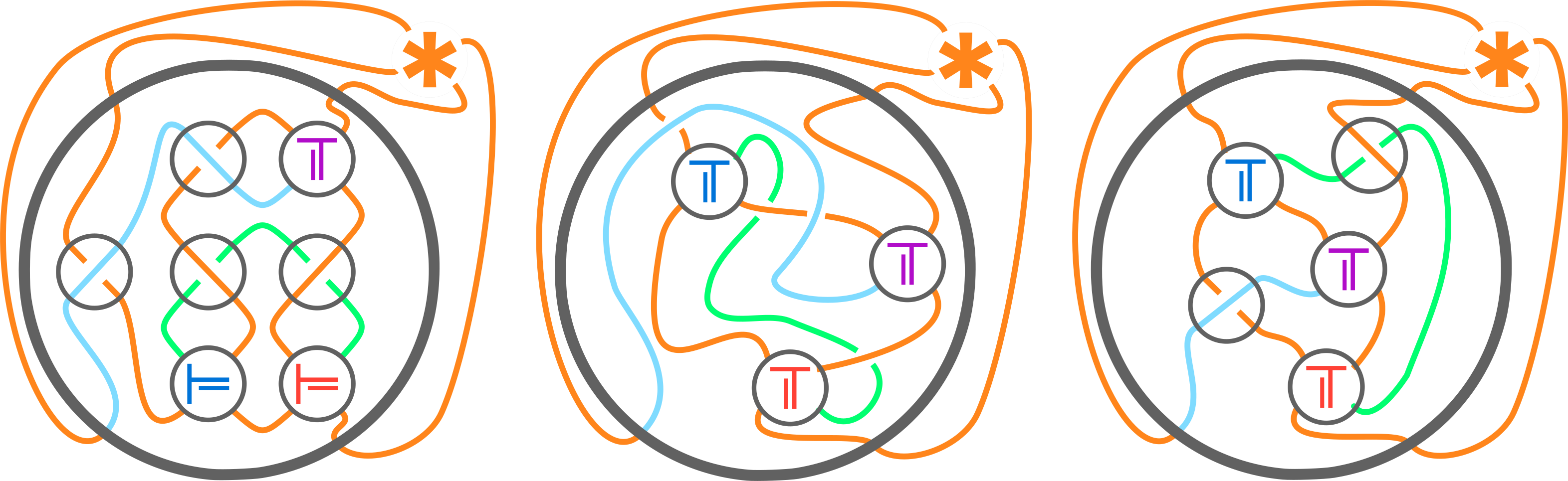
Figure 1:An arborescent tangle being turned into a polygonal tangle via a sequence of interpolated Reidemeister moves.
This leads to two items that must be addressed to ensure the list of tangles contains minimal diagrams.
8.1.1.1Identification of Minimal Arborescent Tangle Representations
The first item, and most straightforward to address, is the identification of a minimal arborescent representative of a given RLITT . This requires the identification of the weighted planar tree related to whose TCN is minimal. We saw in Section 6.2.2.5 the ways canonization can increase complexity in a weighted planar tangle tree. To take to its minimal form, we will need to develop the theory for and an implementation of an efficient algorithm to systematically de-canonize into its minimal arborescent form.
8.1.1.2Identification of Minimal Representations for Arborescent Tangles
Second, and more challenging, is the identification of the minimal representative of a given arborescent tangle. That is, identifying the minimal representative, arborescent or otherwise as in Figure 1. This task requires the development of a classification of the subtrees of a weighted planar tree that correspond to moves of the type similar to that seen in Figure 1. The complexity of this task is compounded by the fact that the family of polygon graphs allowing these types of moves is infinite (easily shown via an induction). Further, the moves that enable arborescent tangles that are minimally polygonal are not limited to the moves on the marked (Figure 1). We can see a second class in Figure 2.
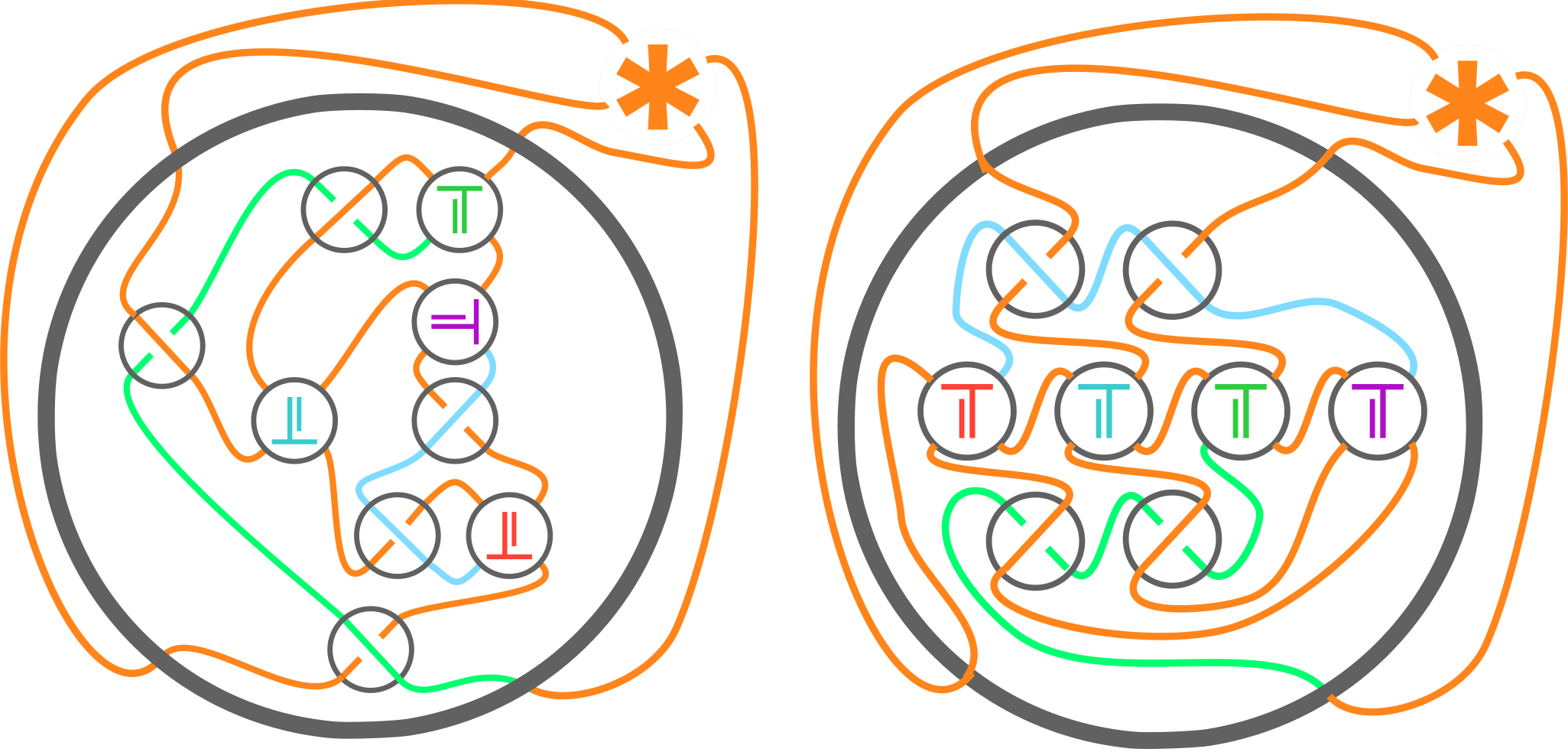
Figure 2:An arborescent tangle turned into a polygonal tangle.
8.1.2Polygonal Tangles
We now discuss the expansion of the tangle tables to include all polygonal tangles up to a target crossing number. Expanding tangle tables to include the polygonal tangles is useful as at high crossing numbers, the polygonal tangles dominate the arborescent tangles. Unfortunately, for the polygonal case, we lack a general classification result. Meaning, as it stands, we have no theoretical mechanism for direct generation of unique representatives for a polygonal tangle as we have done with the classes of tangle in this thesis. The development of a general classification for polygonal tangles is difficult, at least as difficult as a general classification of knots. With this in mind, we will discuss two possible directions for expanding the polygonal tangles.
8.1.2.1Ad Hoc Classification of Constellations
In Tangle insertions, we discussed constellations 3 used for generation of polygonal tangles via insertion. The crossing number of a polygonal tangle is bounded below by the vertex count of its constellation. So the number of constellations represented at reasonable crossing numbers is small. Additionally, when the difference between crossing number and vertex count is low, many of the inserted tangles will have low crossing numbers, again bounding complexity. In his thesis work, Connolly 3 enumerates the ten smallest constellations, those with ten or fewer vertices.
With low vertex count polygons and at low crossing number, developing an ad hoc classification result for each constellation may be a fruitful approach. For example, consider the constellation seen in Figure 3, we can enumerate the possible crossing numbers and locations for tangles to be inserted, Table 1.
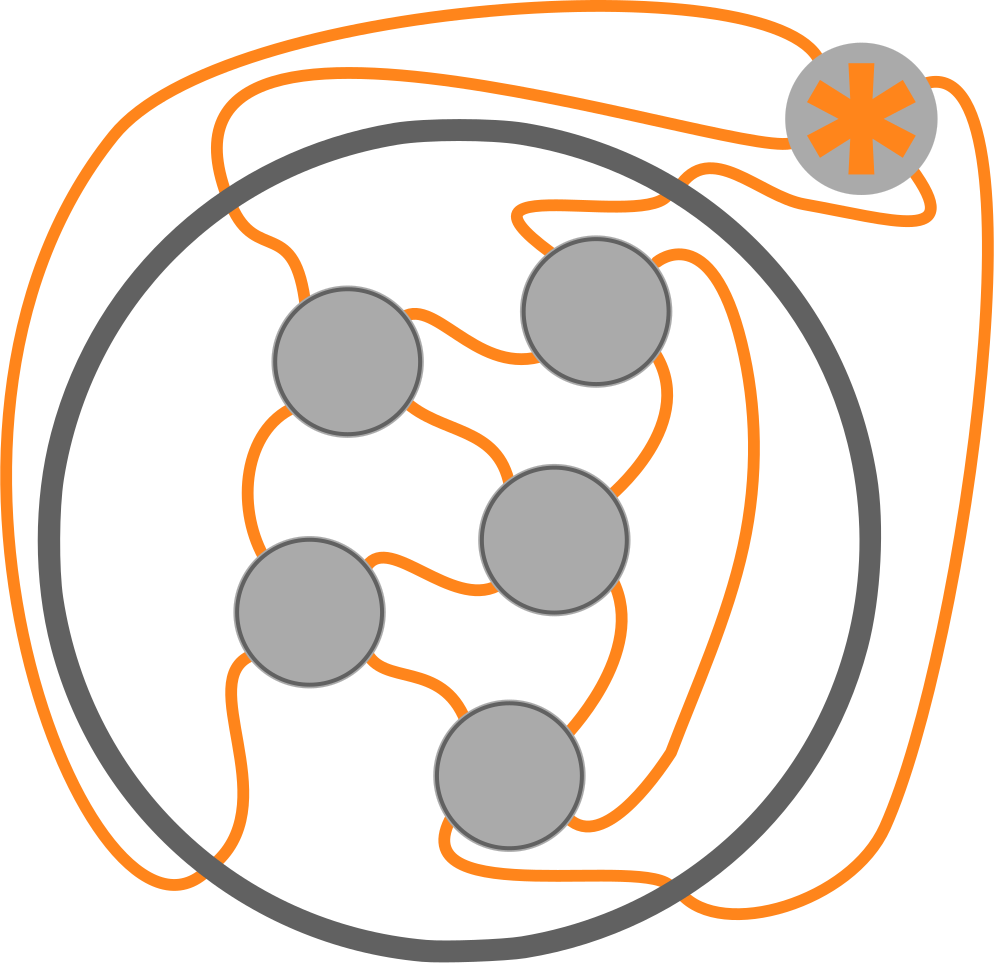
Figure 3:The unique constellation for
We see that up to 7 crossings this constellation only admits rational insertions, at 8 crossings we see our first Montesinos. Completing an analysis of the possibilities for insertion may reveal patterns that allow a classification of this constellation. Even partial results in this arena may yield more efficient heuristics when utilizing the methodology in Section 8.1.2.2.
Table 1:Possible insertions of by crossing number.
| Crossing Number | Possible Crossing numbers for insertion |
|---|---|
| 5 | |
| 6 | |
| 7 |
8.1.2.2Brute Force Tabulation
Without a full or partial classification of the polygonal tangles, we must take an alternative approach to what we have seen in this thesis. That alternative is the brute force, two pass enumeration strategy used in previous knot tabulation efforts 567 and outlined in Section 5.1. The key difficulty in this methodology is the selection of invariants that combine to uniquely identify tangles. This difficulty is due to the fast growth rate for the count of tangles of a given crossing number. This growth rate means any invariant that is selected must have an efficient computation strategy. If, for example, as Burton did 7, we select hyperbolic volume, we may be able to distinguish a large portion of tangles, however computation for crossing numbers as low as 10 will be intractable due to the per tangle time to compute the volume. This says nothing about the raw storage needed to hold the computed and partial data. A seemingly better choice are invariants (Section 5.2.4) which have polynomial time computations, such as those introduced by van der Veen and Bar-Natan (to be published 8). While weaker than hyperbolic volume, these invariants are stronger than the polynomial invariants and faster than both to compute. Statistics for polynomial invariants can be found in Maguire’s thesis work 9.
8.2Tabulation as Undergraduate Research
8.2.1A Research Experience Program for Undergraduates
The accessibility of knot theory was discussed in Section 4.1. This section elaborates on how that accessibility can be leveraged to engage undergraduates in research. Throughout this thesis, we have investigated and observed the depth and complexity of tabulation. We have seen how easily portions of complex tabulation problems can be “peeled off” and decomposed as self-contained problems. Additionally, we discussed product management training (Section 7.1.2) and developed a software engineering life cycle (Section 7.1.3) for use in organizing undergraduate research. These self contained problems combined with our processes, produce a research experience program ideal for undergraduates. The research experience program can be enhanced by sequencing problems with a gradual release of responsibility model as described by Fisher and Frey 10.
We now outline a multi-semester program for training undergraduates, beginning when those students have only lower division (college algebra level) maturity. To begin, we engage in directed reading with low level accessible texts such as this thesis or The Knot Book: An Elementary Introduction to the Mathematical Theory of Knots by Adams 11. When the student has gained a basic understanding of knots, a structured play problem (potentially non-original work) can be introduced. Fitting the need here are problems such as: the sculpting and 3D printing of stick knots[1] in a program such as Blender or OpenSCAD Create Stick Knots: Lower Division Student, the creation of knot mosaics Create Knot Mosaics: Lower Division Student, or quilting Celtic knots Creating Celtic Knots: Lower Division Student. The goal of such an activity is to build wonder and cultivate confidence in the students investigation skills.
As the student matures, their investigation skills improve, and their knowledge base deepens, and they can be presented with more complex reading and novel research problems. Depending on the student’s interest, we present additional but more advanced readings such as LinKnot 12 or accessible research papers such as Burton 7. We should encourage freedom in these readings, allowing students to select sections and formulate questions of their own. At this level, problems should still be well structured having a clear path from start to finish but requiring the filling in of gaps with original work. We should consider problems such as the translation of notations as in Section 8.2.3.3, or the computation of a well understood invariant, as in Section 8.2.3.2.
The program culminates with a mature undergraduate researcher ready to tackle complex problems. At this point we expect the student to have mature reading and reasoning skills but perhaps lack skills such as literature review. Support for reading at this stage should be focused on assisting students in finding answers rather than answers being provided. Students may be prepared to formulate a research question of their own and this should be encouraged; however presenting students with ideas to build on or select from is beneficial. An ideal problem here should fit students interests and have a clear goal but perhaps no clear starting point, for example the random tangle sampling seen in Random Tangle Sampling: Upper Division Student.
8.2.2Infrastructure of a Tabulation Program
One key issue that must be addressed in a tabulation research program is computational needs. Computing on knots and tangles is not necessarily a computationally challenging task. Many problems are simple to describe computationally and have efficient implementations. The primary challenge for tabulation research stems from the raw scale of the dataset, as both the knot and tangle datasets grow exponentially. This exponential growth of the data gives us two primary areas of concern, time to compute and space to store. Even if a problem has a nice constant time or linear time solution, doing a computation on every knot or tangle in our dataset turns the problem into an exponential one, a computational “death by a thousand cuts”.
Generally when research questions run up against computational time constraints, solutions take one of two forms, vertical scaling or horizontal scaling. We will explain the two by analogy. Imagine we are trying to move a large boulder with a bulldozer that is just not powerful enough for the job. We can trade in our bulldozer for a bigger more powerful bulldozer that will push the rock without a problem, this would be vertical scaling. Alternatively, we can blow up the boulder and trade in our bulldozer for multiple smaller bulldozers, each able to simultaneously move bits of the boulder, this would be horizontal scaling. In our tabulation case, we could feasibly use either solution. If we vertically scale, we could complete each computation faster. This makes sense for some computations where each computation is slow such as hyperbolic volume. For other computations, like the grafting seen in Section 6.2.4.2, each computation requires such little computational effort we would quickly run up against data retrieval bottlenecks. In cases like this, distributing the effort horizontally means, with some infrastructure effort, on aggregate we have less idle time in the system. Another key feature of horizontal scaling in our case is the common availability of clusters at primarily undergraduate institutions. These primarily undergraduate institutions often have no access to the large super computers available at large institutions.
The planning and design of infrastructure lead us to address the second challenge, space to store data. We will touch on two points: first the actual storage of the data, and second, accessing and adding to the dataset. As we have discussed, knot and tangle data grows exponentially, as expected, the space needed to store that data also grows exponentially. As a benchmark, we use arborescent tangles and the space required to store them in their linearized form (Section 6.2.4.1).
| Tree Crossing Number | Projected Total Number of Tangles up to TCN | Projected Total Size of Notations up to TCN |
|---|---|---|
| 20 | 20,178,846,455.0426 | 744.93 GB |
| 21 | 77,404,113,447.2751 | 3.02 TB |
| 22 | 296,920,571,662.606 | 12.24 TB |
| 23 | 1,138,987,289,416.26 | 49.59 TB |
| 24 | 4,369,161,597,793.56 | 200.98 TB |
| 25 | 16,760,135,017,593 | 814.55 TB |
| 26 | 64,292,004,387,526.9 | 3.30 PB |
| 27 | 246,624,621,285,968 | 13.38 PB |
| 28 | 946,053,943,972,148 | 54.23 PB |
| 29 | 3,629,070,212,865,634 | 219.77 PB |
As we can see, the space required for storing tangles quickly becomes large. For perspective, a basic storage solution holds at least two copies of the data, meaning to store arborescent tangles up to 21 crossings, we need of disk space (using 4TB as it’s a common disk size). More robust would be a solution that allows for two drive failures such as RAIDZ2, in this case, we require . At approximately per TB, putting us at around for the basic solution and for the robust solution. It’s important to remember this is the required space and cost to store only a sequential list of notations for tangles as in Note making retrieval of a specific tangle difficult.
To expand the list, we require infrastructure that allows for random access, the ability to search the data, and the ability to add additional data. This will require that the data be stored in a database system. Unfortunately, a database does come with a downside, it increases the storage requirements for the data with mandatory overhead. With an effective data model and some consideration of what should be stored and what should be computed on demand, we can mitigate some of this overhead. However, even at low crossing number , we will quickly run into storage issues as we complete undergraduate computation problems.
We will now discuss the selection and design of a database for a table of tangles. Our data will be used by undergraduates, so an ideal database system is one with a data model that has a shallow learning curve. Additionally, our data is largely non-relational, meaning we don’t need a database system geared to relational data. These two items make a NoSQL database system ideal. Just as we had options for vertical scaling and horizontal scaling for carrying out the computations we have the same two options for serving our database. However, in the service case our choice is significantly more clear. Based on the size of our data if we select vertical scaling our cost for a server will be in the (not including storage cost) range and we may still end up with bottlenecks. Therefore, for our needs, horizontal scaling is ideal. In this case we can use a few low-cost cloud servers to store portions of the data, with a coordinator balancing load across the system. If we encounter a bottleneck, instead of buying a whole new expensive server, we simply add another low-cost server to our system. This horizontal scaling concept is called sharding, a feature of MongoDB an ideal choice for our needs.
8.2.3Selection of Undergraduate Projects
In this section we will provide a curated collection of undergraduate research problem statements. We will also give a brief outline for each, contextualizing the problem and describing what phase of the research experience program the problem may be appropriate for:
Lower Division Student: A lower division student is a student with little to no research or abstract math experience. A student at this level should be expected to have completed a college algebra course and started a calculus sequence. For students with a computational background we should expect the student to have started an introduction to programming course.
Intermediate Student: An intermediate student is a student who has some exposure to abstract math. This could take the form of solving a lower division problem. These students should be well into a calculus sequence, having completed calculus II (advanced integration) or calculus III (vector calculus). For students with a computational background we should expect the student to have completed an introduction to programming sequence and started a course on algorithms and data structures.
Upper Division Student: An upper division student is a student who can be expected to work semi-independently. They have solved one or more intermediate student problems, have completed the standard calculus sequence, and have begun abstract math courses. For students with a computational background we should expect the student to have completed a discrete methods course, ideally covering computational complexity theory.
The remainder of the section gives statements for problems appropriate for undergraduate research. The problems in the list fall into five types: visualizations (Section 8.2.3.1), invariants (Section 8.2.3.2), notations (Section 8.2.3.3), generation (Section 8.2.3.4), and potpourri[2] (Section 8.2.3.5).
8.2.3.1Visualization
Visualization and spatial reasoning are critically important for work in knot theory. Problems of the visualization type develop specific visualizations or general visualization tools for knots and tangles.
Create Knot Mosaics: Lower Division Student
Problem Statement
Create a knot mosaic that has a particular property.
Brief
Knot mosaics are a simple method for creating knots from a collection of tiles. Creating mosaics with a particular property, a specific writhe, for example, is a fun and engaging activity where abstraction of a concept can be explored. Modifying the tile set can add additional complexity to the task.
Create Stick Knots: Lower Division Student
Problem Statement
Create stick knots with desired properties.
Brief
Stick knots are knots built from a collection of unit sticks. Creating a physical model by hand or with computer design and 3D printing develops spatial reasoning skills needed for work in higher knot theory.
Creating Celtic Knots: Lower Division Student
Problem Statement
Create Celtic knots with desired properties.
Brief
Celtic knots are common artistic knots. Exploring the creation of a unique rule set for creating Celtic knots is an opportunity to develop a unique understanding of the diagrammatic nuances of knot theory.
Compute Diagram for General Notations: Intermediate Student
Problem Statement
Create an interface for plotting knots in an arbitrary notation in KnotPlot.
Brief
An aspect of knot theory that makes it among the most accessible higher math domains is the ability for anyone to draw pictures of knots. A continuing theme of this thesis is that computations/operations are easy by hand, with the qualifier “up to reasonable crossing number”. This carries through with the drawing of the diagrams. A common drawing tool in knot theory is KnotPlot 13, unfortunately KnotPlot has no interface for drawing knots in “arbitrary” notations. The tool however, does have a Lua scripting interface in which an arbitrary notation decoder can be designed.
Create VR Band Plumbing Visualizer: Upper Division Student
Problem Statement
Create a 3D VR visualizer for the band plumbing construction for arborescent knots.
Brief
The plumbing construction for arborescent knots and tangles is easiest visualized in 3D. The ideal for visualizing these objects is in VR, as this reduces the need for spatial reasoning. While the theory exists for creating the objects, the linear algebra required makes this an upper division problem.
8.2.3.2Invariants
One way to build conjecture is by the analysis of patterns in data, these conjectures often lead to the development of new theory. Problems in this section create the collections of data that can be used for developing those conjectures and theories.
Compute Polynomial From A Tangle Notation: Intermediate Student or Upper Division Student
Problem Statement
Develop the theory needed for efficiently computing polynomials of tangles
Brief
One of the most important advancements in knot theory was the discovery of knot polynomials as a class of knot invariants. As an example, one of the most powerful of these polynomials is the HOMFLYPT polynomial 14 constructed from the skein relations equation Figure 4.
Conveniently, the data needed to apply the skein relations is precisely the data encoded by RLITT, relative crossing data.

Figure 4:The skein relation for the HOMFLYPT polynomial. (Public domain, via Wikimedia Commons 15)
Depending on the polynomial selected, the problem is appropriate for intermediate students or upper division students. When the polynomial has a developed tangle theory, the solution will have a well defined start and end point and is appropriate for intermediate students. Otherwise, the full tangle theory must be developed. This requires experience with the development of original abstract theory, making the problem appropriate for upper division students.
Compute Finite Type Invariant From A Tangle Notation: Intermediate Student or Upper Division Student
Problem Statement
Develop the theory needed for efficiently computing a finite type invariant of tangles
Brief
Similar to the computation of polynomial invariants the computation of finite type invariants expands our table with data useful for binning future tangles and knots. Depending on the invariant selected, the problem is appropriate for intermediate or upper division students. When the invariant has a developed tangle theory the solution will have a well defined start and end point and be appropriate for intermediate students. Otherwise, the full tangle theory must be developed. This requires experience with the development of original abstract theory, making the problem appropriate for upper division students.
8.2.3.3Notations
There are many ways to encode the data of a knot, each with advantages and disadvantages. Throughout this thesis, the primary target notation was the RLITT Section 6.2.3. This subsection discusses several useful notations where a computational tool translating from and to RLITT is desired. Since the source and destination notation in each problem are well understood each is appropriate for intermediate students.
Notation Description for Extended Gauss Notation: Intermediate Student
Problem Statement
Develop the theory translating RLITT to extended Gauss notation. Additionally, develop the software needed for storing and translating per theory.
Notation Description for Planar Diagram (PD) Notation: Intermediate Student
Problem Statement
Develop the theory for translating RLITT to PD notation. Additionally, develop the software required for storing and translating per theory.
Notation Description for DT Notation: Intermediate Student
Problem Statement
Develop the theory for translating RLITT to DT notation. Additionally, develop the software needed for storing and translating per theory.
8.2.3.4Generation
This section expands the census of tangles to more abstract classes. These expanded lists increase accessibility of complex objects allowing for the creation of new theory.
Create a table of virtual tangles: Upper Division Student
Problem Statement
Create the theory needed to construct a table of virtual tangles.
Brief
Virtual knots, developed by Kauffman 16, are an extension of the knot concept where a knot shadow need not be planar. Some work has been done on classifying the virtual tangles by Mellor and Nevin 17. The full tangle theory must be developed to solve this problem. This requires experience with the development of original abstract theory, making the problem appropriate for upper division students
Create a table of string tangles: Upper Division Student
Problem Statement
Create the theory needed to construct a table of string tangles.
Brief
The tangles we have worked with in this thesis are the two string tangles, those with four fixed points on the Conway circle. A natural extension to this concept is the string tangle. Recently, Kwon 18, the 3 strings rational tangles, have been classified. For the remaining cases, the full tangle theory must be developed to solve the problem, this requires experience with the development of original abstract theory, making the problem appropriate for upper division students
8.2.3.5Potpourri
Problems in this section are those that do not fit into other classes of problems.
Random Tangle Sampling: Upper Division Student
Problem Statement
Create the theory and software to select from a collection or generate a tangle at random with an understood distribution.
Brief
In the introduction chapter Section 4.2, applications of knots to the hard sciences were discussed. When working in the hard sciences, being able to sample with an understood distribution from a collection is important. Similarly to the previous notational projects, describing and implementing random sampling methodologies is a class of extremely useful tabulation projects. The full tangle theory must be developed to solve this problem. This requires experience with the development of original abstract theory, making the problem appropriate for upper division students
Develop a tangle analogue for petal knots: Upper Division Student
Problem Statement
Create the theory needed for a well defined tangle analogue of the petal knots19.
Brief
Petal knots, first developed by Adams 19, are knots in which all crossings are collinear in the orthogonal projection, an “ubercrossing”. Converting these objects to a braid is straightforward, however less obvious is converting to a two string tangle. Identifying a tangle analogue for the petal knots may allow for computation of a whole new family of tangle data. The full tangle theory must be developed to solve this problem. This requires experience with the development of original abstract theory, making the problem appropriate for upper division students
- Gren, B. A., Sulkowska, J. I., & Gabrovšek, B. (2025). Classification of Algebraic Tangles. https://arxiv.org/abs/2504.06901
- Conway, J. H. (1970). An Enumeration of Knots and Links, and Some of Their Algebraic Properties. Computational Problems in Abstract Algebra, 329–358. 10.1016/B978-0-08-012975-4.50034-5
- Connolly, N. (2021). Classification and Tabulation of 2-String Tangles: The Astronomy of Subtangle Decompositions. University of Iowa. 10.17077/etd.005978
- Cook, S. A. (1971). The Complexity of Theorem-Proving Procedures. Proceedings of the Third Annual ACM Symposium on Theory of Computing - STOC ’71, 151–158. 10.1145/800157.805047
- Dowker, C. H., & Thistlethwaite, M. B. (1983). Classification of Knot Projections. Topology and Its Applications, 16(1), 19–31. 10.1016/0166-8641(83)90004-4
- Hoste, J., Thistlethwaite, M., & Weeks, J. (1998). The First 1,701,936 Knots. The Mathematical Intelligencer, 20(4), 33–48. 10.1007/BF03025227
- Burton, B. A. (2020). The Next 350 Million Knots. LIPIcs, Volume 164, SoCG 2020, 164, 25:1-25:17. 10.4230/LIPICS.SOCG.2020.25
- van der Veen, R., & Bar-Natan, D. (n.d.). Knot Invariants from Finite Dimensional Integration. https://drorbn.net/AcademicPensieve/Talks/Geneva-2408/IType.pdf
- Maguire, R. J. (n.d.). Khovanov Homology and Legendrian Simple Knots.
- Fisher, D., & Frey, N. (2013). Better Learning Through Structured Teaching: A Framework for the Gradual Release of Responsibility (2nd ed). ASCD.
- Adams, C. (2004). The Knot Book: An Elementary Introduction to the Mathematical Theory of Knots. American Mathematical Society.
- Jablan, S. V., & Sazdanović, R. (2007). LinKnot: Knot Theory by Computer. World Scientific.
- Scharein, R. G. (1998). Interactive Topological Drawing.
- Freyd, P., Yetter, D., Hoste, J., Lickorish, W. B. R., Millett, K., & Ocneanu, A. (1985). A New Polynomial Invariant of Knots and Links. Bulletin of the American Mathematical Society, 12(2), 239–246. 10.1090/S0273-0979-1985-15361-3
- Pbroks13. (2008). Skein (HOMFLY). https://commons.wikimedia.org/wiki/File:Skein_(HOMFLY).svg