6.1The First Tangle Datasets
This chapter will describe the methodology used to answer two of the essential questions detailed in Section 4.3.
“How do I systematically construct rational tangles?”, “How do I tell two rational tangles I make apart?”, and “How do I generate new rational tangles?”
“How do I systematically construct Montesinos tangles?”, “How do I tell two Montesinos tangles I make apart?”, and “How do I generate new Montesinos tangles?”
The methodologies outlined in this section are for relatively simple classes of tangles, the rational and Montesinos tangles. As we progress, we will see a common solution pattern that outlines the general approach to the more difficult algebraic/arborescent case in Section 6.2. That approach takes the form of the cadence:
Define the object.
Define equivalence for the object.
Identify a unique representation.
Generate those unique representatives[1]
6.1.1Rational Tangles
We will see in this section that rational tangles, originally described by Conway 1, have a deeply combinatorial nature, making them among the simplest classes of tangle. This simplicity leads to the rational tangles, and their knot closures, being some of the most commonly studied objects in knot theory.
6.1.1.1Construction
In our development of the modified tangle calculus (Section 5.3.2) we described a way to glue tangles together, allowing us to take simple objects and build complex objects. That approach forms the basis for our construction of the rational tangles.
We start, with an intuitive description of the construction. Imagine a zero tangle (Figure 9a), now attach to that tangle a crank on the right (east) side (Figure 1). We allow, for a moment, the fixed points of the tangle to move. If we crank a half turn clockwise or anti-clockwise, we introduce a twist, if we turn the crank half turns we make an integral tangle(Section 5.3.3).

Figure 1:A set of three turns, changing a basic 0 tangle into an integral 3 tangle.
When we have completed turns we take the crank and move it to the bottom (south) side of the tangle. We turn the crank to add half turns, this time building a vertical integral tangle. Continuing this, alternating between right and bottom sets of half turns, as seen in Figure 2, a rational tangle. For a rational tangle , the list of counts for right and bottom twists is the twist vector (Definition 2) of the rational tangle.
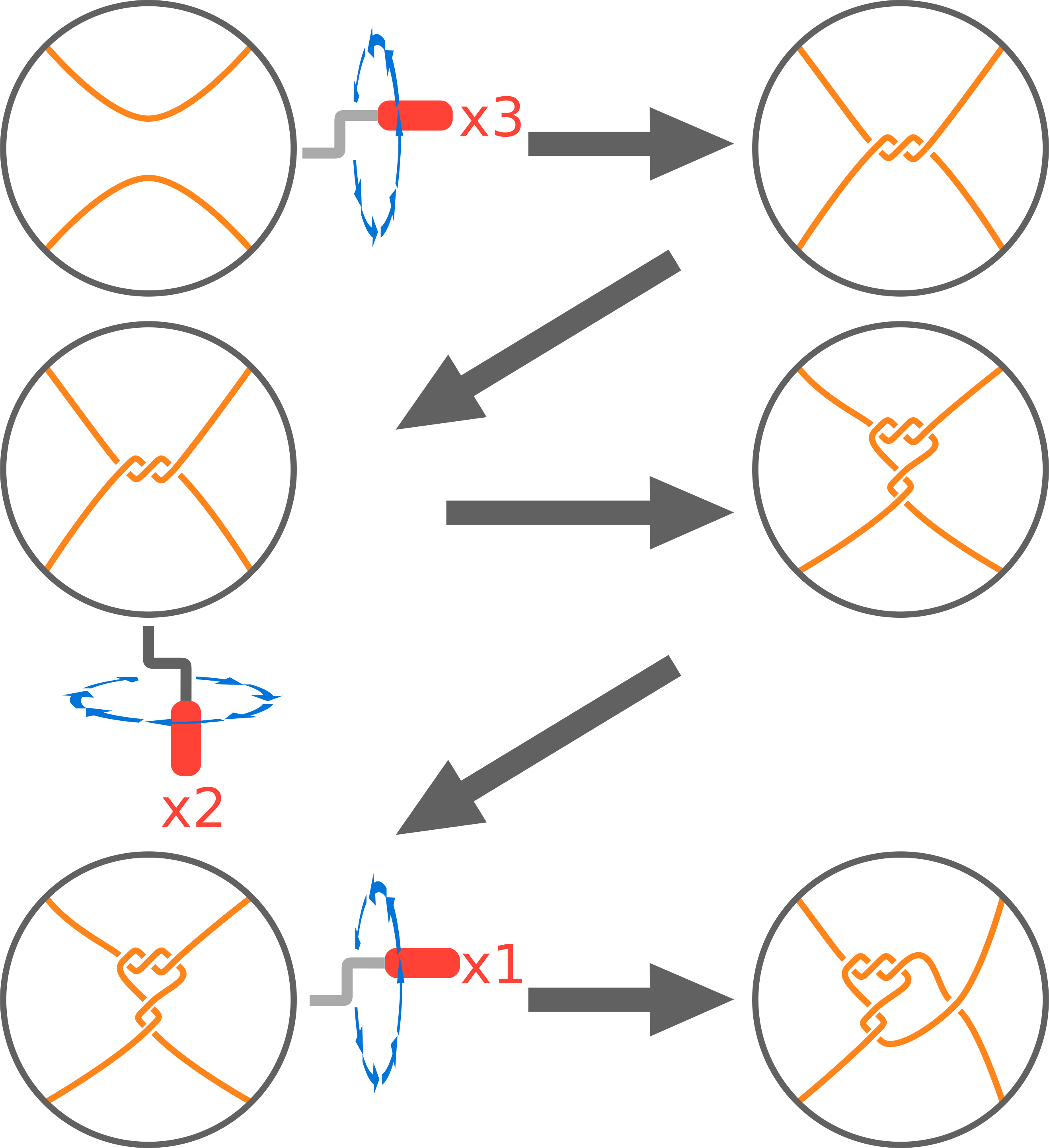
Figure 2:The set of alternating turns building a rational tangle .
Formalizing this intuitive construction requires the and operations (Section 5.3.2), as well as the integral tangles (Section 5.3.3). This formalization was originally stated by Conway 1 but was ultimately proved by Burde and Zieschang, we will give a later construction by Kauffman and Goldman 2. For convenience, we denote a horizontal integral tangle with crossings as , similarly, a vertical integral tangle with crossings as .
To see the alignment between Definition 1 and our intuitive construction, view the turning of the crank as corresponding to horizontal and vertical integral tangles, and the alternating of right and bottom as corresponding to alternating and .
Correspondence With Extended Rational Numbers
Now we formally address our first two essential questions by:
Describing a notation for rational tangles.
Demonstrating a correspondence between the rational tangles and the extended rational numbers.
Showing that the correspondence distinguishes (tells apart) rational tangles.
The answer to our first essential question, “How do I systematically construct rational tangles?”, is seen by formalizing the twist vector notational strategy we saw in our intuitive formulation for rational tangles. This allows us to systematically write down a rational tangle by a list of integers.
We are now ready to answer the second of the essential questions, “How do I tell two rational tangles I make apart?” The critical observation to answer the questions is due to Conway’s use 1 of the entries of a twist vector as the entries for a continued fraction (Definition 3). Since the twist vector is of finite length, this continued fraction corresponds to an extended rational number 3, .
Kauffman and Goldman 2 prove (Theorem 1) that this correspondence distinguishes, tells apart, rational tangles. Meaning, given two rational tangles, if their fractions are the same the tangles are isotopic, and if the fractions are different, the tangles are not isotopic. This answers the second of our essential questions.
Observe, Theorem 1 does not discount the possibility of two non-equivalent twist vectors, those differing in at least one entry, representing the same rational tangle. Example 1 demonstrates that the possibility is true. In fact, for each rational tangle, the set of twist vectors representing it is infinite.
To effectively answer our third essential question, “How do I generate rational tangles?”, we will need to determine a unique twist vector representative for each rational tangle. A unique representative allows us to simply and efficiently write down each tangle without risk of duplicates showing up on our list.
6.1.1.2Canonical Twist Vectors
Identifying a unique representative will stem from properties of finite continued fractions. We start by defining a specific subclass of finite continued fractions with integer coefficients, the regular continued fractions. We frame the definition in the context of twist vectors.
Conveniently, each extended rational number corresponds to exactly two regular continued fractions 3. The first is a twist vector with the leftmost element greater than or equal to 2, and the second with leftmost element equal to 1, per (5). Observe, one of these twist vectors has an even number of entries, and one has an odd number of entries.
To identify a unique representative for a rational number and hence rational tangle, we will select, for convenience, the odd length twist vector as our unique representative.
6.1.1.3Computational Methods
Armed with a unique representative for a rational tangle, we can construct our computational answer to the third essential question.
Notation
We start by describing how we will digitally store a rational tangle. In the rational tangle case, the theoretical encoding strategy of twist vectors happens to be well suited for computational storage. A twist vector can be computationally stored identically to its written form, a list of space separated integers delimited by a pair of square braces, . As we will see in Section 6.2 this direct translation of theoretical notation to computational notation is not always the case.
Generation
A common tactic in the knot tabulation space is to pare down the number of items that must be tabulated by leveraging symmetries of the objects being tabulated. For example, the and tangles are related to each other by a minus operation (Minus Tangle). Meaning, if we tabulate , we can recover with multiplication by . This fact holds for all rational tangles as demonstrated by Lemma 1. Allowing us to focus our efforts on the rational tangle with twist vectors containing only positive entries.
We now begin our development of a generation strategy for twist canonical twist vectors of rational tangles. The method seen here utilizes a common combinatorial method for defining compositions of integers, the same is used for rational tangle counting by Bryhtan 6. Consider, for a given crossing number , what is the most “obvious” twist vector? A viable candidate for most “obvious” is a twist vector, of the form seen in (6), dropping the trailing 0 where needed.
The 1’s twist vector (6) is an ideal starting point for developing a generation strategy, as it distributes the data of a rational tangle as broadly as possible. Next, we consider how we might transform the 1’s twist vector into a twist vector with a two crossing integral components. We can do this by exchanging the space between the first and second 1 with a numeric .
This process tells us that we can utilize the exchange of whitespace of a twist vector for to generate new twist vectors. To complete our generation, we must generate every combination of exchanges.
The 1’s twist vector with crossing number has 1s and spaces. In each space position, we have the option between a space and . To enumerate all combinations, we can simply count, in binary, from 1 to , as in Example 2.
Our final refinement in this process it to transform this collection into canonical twist vectors. Half of the twist vectors, those of odd length, generated in this process are already canonical. To canonize the even length twist vectors, we append 0 to the right most position of each list, turning the even vectors into an odd canonical vectors.
We conclude the section with a set of algorithms that describe a method for computationally generating all rational tangles up to a given crossing number.
6.1.2Montesinos Tangles
In this section, we will use the rational tangles to build a yet more complex class of tangles, the Montesinos tangles. This building up process demonstrates one of the core strategies for tangle tabulation.
6.1.2.1Construction
With the rational tangles in hand, we wish to utilize that data to enumerate additional tangles. One way we have seen to build simple objects into complex objects is to combine two tangles with the or operation. To keep complexity under control, we start with combining tangles with repeated sum. When all summands, in equation (9), are rational, we call the result of the sum a Montesinos Tangle 78.
Unique Representative
Next, we develop a classification of Montesinos tangles, allowing us to tell two Montesinos tangles apart. For each rational summand in a Montesinos tangle, we have four possibilities:
’s canonical twist vector is positive and ends in 0
’s canonical twist vector is positive and does not end in 0
’s canonical twist vector is negative and ends in 0
’s canonical twist vector is negative and does not end in 0
Observe that in the second and fourth cases, terminates in a horizontal integral tangle. In these cases, the tangle can be simplified by using the flype (The Flype) to move the horizontal crossings to be the right most summand, seen in Figure 3. When this process is carried out for each summand of the type in cases two and four, the resulting summands all fall into cases one and three.
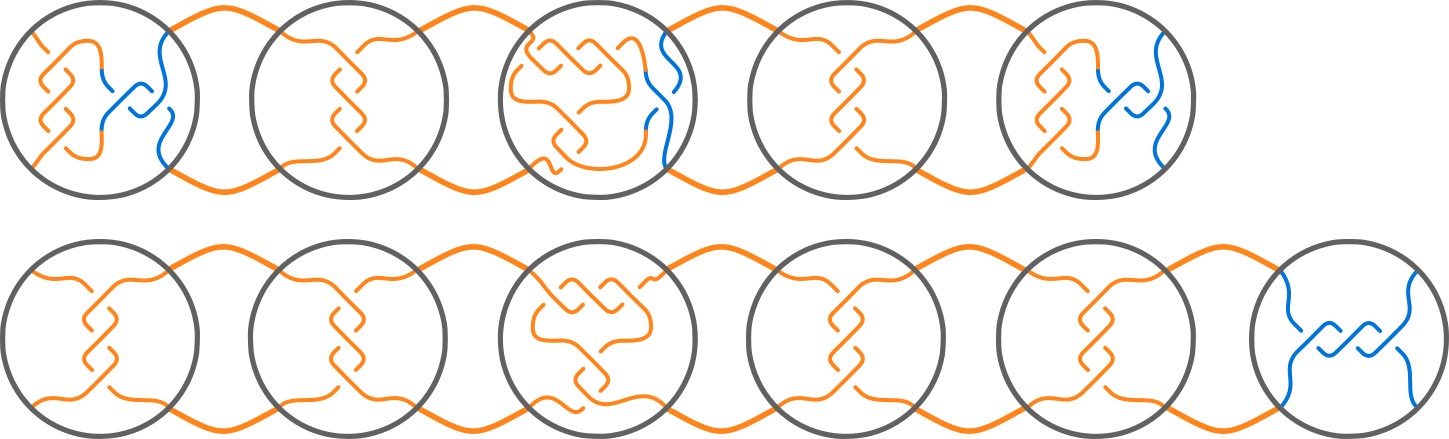
Figure 3:A Montesinos tangle
simplifying to
We will now pare down to a single possibility, case one. Consider a summand in case three, meaning except for , which may be integral. Theorem 1 tells us that if we can find an alternative, potentially non-canonical, twist vector that fits our needs, we are free to exchange without impacting topology. What we would like is an odd length twist vector, where every entry is positive, except for the rightmost, which is a negative value, see Figure 4.

Figure 4:On the left rational tangle and on the right . These tangles have fractions and showing the tangles to be isotopic.
This ensures that the fraction is still negative but will allow us to flype the terminal horizontal integral tangle to the right. Rockett and Szüusz give a lemma that establishes the existence of such a twist vector for each rational number.
We have now shown that each case (2,3,4) can be transformed into the first case, and we can define a canonical form for Montesinos tangles.
6.1.2.2Computational Methods
Notation
Before we can generate Montesinos tangles, we need to define an efficient notation for computation and storage. Similar to what we saw in the rational tangle case, the theoretical notation for Montesinos tangles is sufficient for computation. However, with eyes on future computational work, we will generalize our notation to increase reusability and the efficiency of storage.
Montesinos tangles are simple forms of the algebraic tangles (Definition 7), so we will build a notational strategy for general algebraic tangles. The strategy seen here is similar to those found in Conolly, Caudron , and Gren, Sulkowska, and, Gabrovšek 91011. The theoretical notation for algebraic tangles is outlined in Section 5.3.2 and seen in Example 3. We can simplify the notation, without losing fidelity, by substituting the integral leaf tangles for rational tangle twist vectors. Additionally, we can improve the storage overhead by storing the tree as a string in Polish notation 12. Storing in Polish notation allows us to drop all the parentheses from our notation, saving two bytes in each instance.
Generation
In this section, we will design an algorithm that allows us to efficiently generate new Montesinos tangles up to a given crossing number. As we saw, the construction of a Montesinos tangle is based on the repeated summation of rational tangles. Consequently, our generation strategy will utilize our table of rational tangles.
To start, we need a mechanism that allows us to select all possible combinations of rational tangles with crossing numbers that sum to our target. For a Montesinos tangle , the set of rational components combined with the integral component corresponds to an ordered list of crossing numbers as in (10).
We call a list of the form seen in (10) a stencil for a Montesinos tangle. By construction, every canonical Montesinos tangle relates to precisely one stencil. Observe, that since is the lowest crossing number rational tangle with fraction in the unit interval.
Generation for all Montesinos tangles of a given crossing number at this point can be broken down into two steps:
Generate all stencils
Fill in the stencils with all rational tangles of the appropriate crossing number whose fraction is in the unit interval (plus an integral tangle in the rightmost position)
For the first step, we require a mechanism for breaking an integer into all possible combinations where the parts sum to the integer. Luckily, we have already seen how to do this, in the context of a twist vector. We follow the same counting algorithm outlined in Algorithm 1 however, we modify the algorithm to keep both the even and odd outputs, but filter out stencils with entries less than two.
For the second step, for each entry in the stencil we create a list of rational tangles in the unit interval with that entry for a crossing number. For the rightmost entry of the stencil we also include the horizontal integral tangles with crossing number equal entry. This creates all combinations of input tangles given by the stencil.
We conclude the section with a set of algorithms that describe this method for computationally generating all Montesinos tangles up to a given crossing number.
6.2Arborescent Tangles
This section describes the methodology we use to answer the final of the essential questions detailed in Section 4.3.
“How do I systematically construct algebraic/arborescent tangles?”, “How do I tell two algebraic/arborescent tangles I make apart?”, and “How many algebraic/arborescent tangles can I create?”
In this thesis so far we have worked with the algebraic tangles (Definition 7) constructed with Conway’s tangle arithmetic (Operations on Tangles).
In this section we will leverage a slightly different, but equivalent, construction given by Bonahon and Siebenmann 8 the arborescent tangles. The one-to-one correspondence between the classes will become clear as we introduce the construction for arborescent tangles.
This section starts with an overview of Bonahon and Siebenmann’s 8 definition of arborescent knots and tangles (Section 6.2.1). We then give their smooth and combinatorial constructions of arborescent knots and tangles (Section 6.2.2). Next, we give original work extending Bonahon and Siebenmann’s canonical construction to a local view (Section 6.2.2.4). This local view is leveraged to define a unique representative for each class of arborescent tangles (Section 6.2.3). Finally, we will describe an original algorithm and notation that directly enumerates those unique representatives (Section 6.2.4).
6.2.1Definition of Arborescent
We now give a high-level description of the manifold theory underpinning the theory of arborescent knots and tangles. A full treatment of the manifold theory can be found in Bonahon and Siebenmann 8. Our first concept is that of a knot pair, which serves as the underlying structure for all the smooth objects in this subsection.
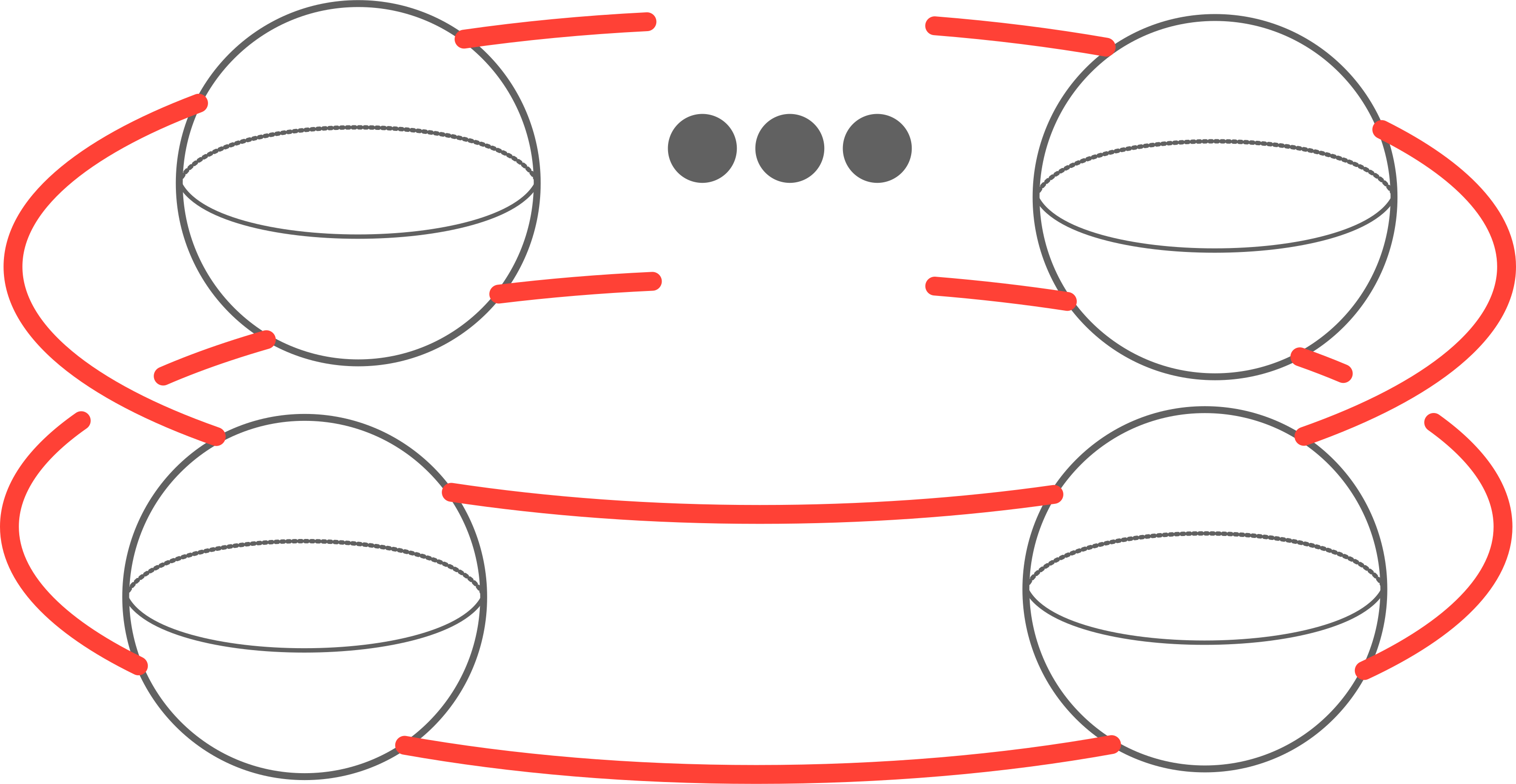
(a)The arborescent vignette from Figure 5 seen with Conway spheres.

(b)The arborescent vignette showing a 1 crossing tangle to be arborescent.
Figure 6:Arborescent vignettes.
Observe that arborescent knots are characterized by a collection of Conway spheres (circles). Choosing to not fill one, or more, of these Conway spheres yields a tangle.
We see from the above the first portion of the correspondence between the algebraic and arborescent tangles. Each algebraic tangle can be naturally decomposed into a collection of nested arborescent knot vignettes given by its operations and .
6.2.2Weighted Planar Trees
6.2.2.1Construction of Arborescent Knots from Weighted Planar Trees
This subsection begins with an introduction to Bonahon and Siebenmann’s 8 construction of arborescent knots and tangles in the smooth setting. This is followed by the development of a combinatorial representation for arborescent knots and tangles 8. We deviate slightly from Bonahon and Siebenmann’s introduction but ultimately arrive at the same structure. In our introduction we develop partial solutions, then progressively modify those partial solutions until they fit our needs. Next, we describe Bonahon and Siebenmann’s 8 operations on the combinatorial structure, which allow us to systematically modify the structure without changing the topology. This subsection finishes with the classification of arborescent knots and tangles given by Bonahon and Siebenmann 8 as well as our extension from a global to local viewpoint.
Bands and Plumbing Squares
Our first step in describing a notation for the arborescent knots 8 is describing a plumbing operation on bands. A band with a plumbing square is a band , along with an oriented square on the band such that two of the sides of the square intersect the boundary of the band. Two examples of bands with plumbing squares can be seen in Figure 7.

(a)A band with a plumbing square facing the viewer.

(b)A band with the plumping square facing away from the viewer. We are looking through the band.
Figure 7:Plumbing squares of bands.
Plumbing bands
We now glue the bands seen in Figure 7 together with an operation called plumbing. Consider the orientation given in the green band’s plumbing square. We will call the blue arrow and the thicker red arrow ; similarly for the blue band with and . We plumb the bands together along their plumbing squares, with the requirement that the orientation labels are mapped and . Finally, we forget the boundaries of the plumbing squares, leaving only the joined boundaries of the bands. The result of plumbing as well as a local picture for plumbing can be seen in Figure 8.

(a)Plumbed bands

(b)Plumbed bands
Figure 8:Two bands plumbed.
Our plumbing band construction can be turned into a knot by adding a series of half-twists to our plumbing bands (Figure 9a and Figure 9b). When forming the half twists, we have two options for direction relative to the band, we call one positive (left handed twists) and one negative (right handed twists). We note that the twists appear in unique regions of the band, determined by their position relative to the plumbing squares.

(a)Band with two negative half twists
and three plumbing squares.

(b)Band with three positive half twists and one plumbing square.
Figure 9:Plumbing bands with twists.
Successive plumbing yields collections of bands like those seen in Figure 10a. Finally, turning Figure 10a into a knot is as simple as removing the interior of the band, leaving only the boundary, per Figure 10b.

(a)Bands plumbed

(b)An arborescent knot.
Figure 10:A set of plumbed bands in Figure 10a and arborescent knot in Figure 10b
It is important to note that, for creating arborescent knots, we must restrict plumbing from creating “cycles” of bands. That is a chain of plumbing beginning and ending with the same band, as seen in Figure 11. If we allow cycles in the bands, we may create a polygonal tangle, defined in Tangle insertions. These polygonal tangles contain portions that do not satisfy Definition 8, so are not arborescent presentations.
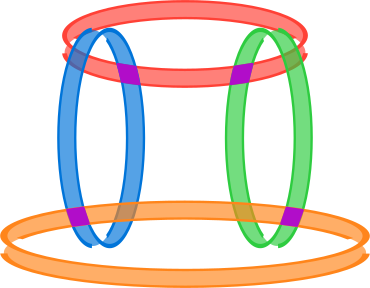
Figure 11:A collection of bands plumbed in such a way that the last band is plumbed to the first band in a cycle.
We now establish some language for describing the relative positions of bands. This language will be reused when we transition to the combinatorial setting and is widely used in graph theoretic settings.
We claim the plumbing band construction is in correspondence with the definition of arborescent seen in Definition 7. To see this, we take each plumbing band and encapsulate it in a so that the corners of the plumbing squares lie on the , giving us the vignette seen in Figure 6a.
Weighted Planar Trees
The band construction we have developed for arborescent knots, as it stands, is completely unsuited for machine computation. In this subsection, we lay out a line of reasoning leading to a combinatorial encoding strategy 8 for the plumbing band construction of arborescent knots and tangles. The line of reasoning starts by presenting the required data of arborescent knots and tangles that any combinatorial representation must encode. We then propose partial solutions, each progressively closer to the full encoding described by Bonahon and Siebenmann 8. As we will see, the encoding strategy ultimately takes the form of a modified rooted plane tree, a specialized flavor of graph theoretic tree.
Inventing a combinatorial encoding strategy means we first have to identify the essential information that is needed to construct arborescent knots and tangles from band plumbings. The two essential pieces of information that must be encoded by any combinatorial strategy for notating plumbing of bands are the following:
The parent child relationship between bands
The twists on bands, and their positions relative to the band’s children (plumbing squares)
Explicit details expanding on why these two pieces of information are essential can be found in Bonahon and Siebenmann 8. We will see in the following subsections ways in which these data are essential, albeit in specialized cases.
Consider the first piece of essential information our combinatorial strategy must encode, the parent child relationships between bands. Perhaps the most commonly computationally utilized structure that encodes relational data is an abstract graph. We imagine how an abstract graph might be used for encoding the relationship of bands. One solution is to map bands to vertices and plumbing relationships to edges. In the discussion of the band construction, we restricted plumbing from forming cycles (Figure 11). A result of this restriction is that any abstract graph must also have no cycles, meaning all the graphs we will work with, abstract or otherwise, are actually trees. We will call the data of a vertex and a collection of bonds (half-edges) associated with plumbing squares the local picture around a vertex.
We have partially completed our goal of encoding the essential information of band plumbing in a combinatorial object. Unfortunately, an abstract tree doesn’t encode all the essential data. Particularly, our second piece of information, the positions of children and weights, is not easily seen in an abstract tree. To solve this problem, we will instead use a modified version of an abstract tree, a rooted plane tree, for our encoding.
In a rooted plane tree , at each vertex , the children of have an ordering inherited from the total order of , we call this ordering of the children the cyclic order of the children. The cyclic order gives us two natural ways to draw and its children in the plane. We may choose to draw the children anti-clockwise in one of increasing or decreasing order of index. The realization of these two options can be seen in Figure 12. A universal choice of increasing or decreasing yields a unique realization of a rooted plane tree in the plane.

(a)The local picture of a vertex with child labels increasing in anti-clockwise order.

(b)The local picture of a vertex with child labels decreasing in anti-clockwise order.
Indexing the total order of a tree
We will now describe an ideal indexing for a rooted plane tree.

(a)A rooted plane tree with ideal indexing. The index of each vertex is seen inside the vertex.

(b)A rooted plane tree with indexing that is not ideal. The index of each vertex is seen inside the vertex.
Figure 13:Indexing strategies of a rooted plane tree.
The final data we need to record is the position and count of half twists relative to plumbing squares. We observed earlier that the half twists on a band must lie in a unique region determined by position relative to plumbing squares on a band. This relationship can be recreated for a rooted plane tree by annotating the local view of a vertex with an integer placed in the regions between bonds. The relationship between a plumbing band and a weighted vertex in a rooted plane tree can be seen in Figure 14a. The weights placed in regions between bonds inherit a cyclic order from the cyclic order of the bonds. Each weight falls in the region between two bonds. We assign to each weight (including zero weights) the lower of the two indices. This aligns with assigning to the weight the index that appears before it in the anti-clockwise planar realization of the cyclic order, per Figure 14b.

(a)The local view of a vertex with the weights two, zero, and zero.

(b)The local view of a vertex with weight. Notice the index of the weights comes from the bond “before” it in the planar realized cyclic order.
Figure 14:Local view of a vertex with weights.
We can see a full example of a tree with its associated plumbed construction in Figure 15a. We call this fully realized combinatorial recipe for an arborescent knot a weighted planar tree.
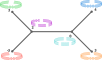
(a)The tree describing the plumbing of bands. Each vertex represents the band illustrated near it.
(b)The realization by plumbing bands of the tree in Figure 15a
Figure 15:Realization of plumbing of a tree.
Weighted Planar Tangle Trees
Our construction to this point has been concerned with the notation for knots and links. We now give a modification of this notation for tangles. A weighted planar tree, as in Figure 17a, can be modified to represent a tangle by allowing a free bond (half-edge) to be attached to a vertex, that is, to allow bands to have a non-plumbed plumbing square. We realize the non-plumbed square as a Conway circle for a two string tangle as in Figure 17b. To consistently orient the Conway sphere’s interior, we align the north boundary points of the Conway sphere with the top (up in the band orientation) boundary component and place the NW corner first (following the orientation of the boundary), per Figure 16. Plumbing two bands then corresponds to the action of gluing a pair of tangles together on their Conway spheres so that boundary points align.

Figure 16:The orientation of a Conway sphere is given by a plumbing square on a band of an arborescent tangle. The orientation of the underlying plumbing square is shown. This aligns with a left hand rule with the thumb, the index finger, and middle finger, with pointing away from the center of the band, out of the page in this case.
A tree may have many free bonds, with each free bond representing a unique boundary Conway sphere. Each boundary component serves as a location where a tangle can be inserted to form a knot or link. For our efforts in enumerating two string tangles, we restrict our focus to trees that have a single free bond. In tangle trees with a single free bond, we designate the vertex with the free bond as the root of the tree.

(a)The plumbing realization of an arborescent tangle.

(b)With an isotopy of the tangle and inversion of the Conway circle given by the non-plumbed square we have the realization of Figure 17a as a traditional orthogonally projected tangle.
Figure 17:Plumbing bands as a tangle.
We will see that keeping track of the location of the fixed points of the boundary sphere is important when determining tangle equivalence. This is due to the need to maintain the rational number (Definition 3) associated with the “rational tangle” subtangles of a tree, prompting us to assign rotation information to the free bonds. This information takes the form of labels from the members of of the Klein four-group . Each of these labels corresponds to a rotation of the Conway sphere around an axis in , as seen in Figure 18 and Figure 19. Full details for the manifold theory underpinning these markings are found in Bonahon and Siebenmann 8. We call such a labeled tree a weighted planar tangle tree.

(a)The identity rotation (no rotation)
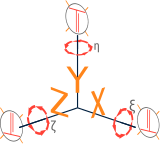
(b)The effect of the rotations on each of the
Figure 18:The identity rotation (no rotation) and the effect of the rotations on each of the
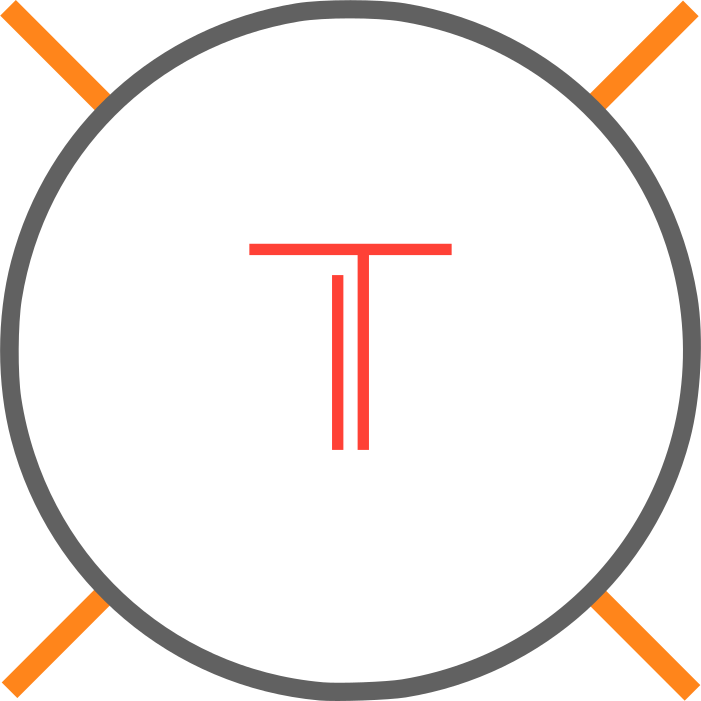
(a) for no rotation
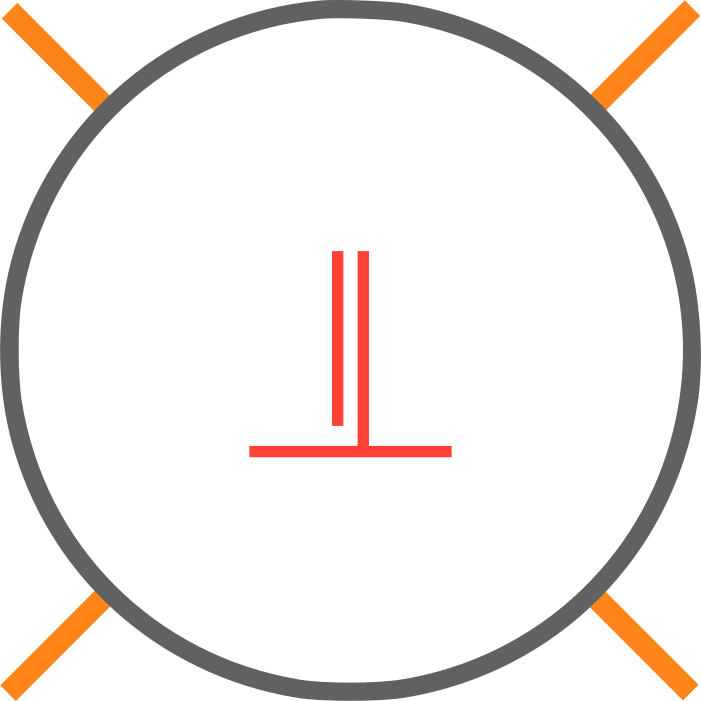
(b) rotates around the -axis
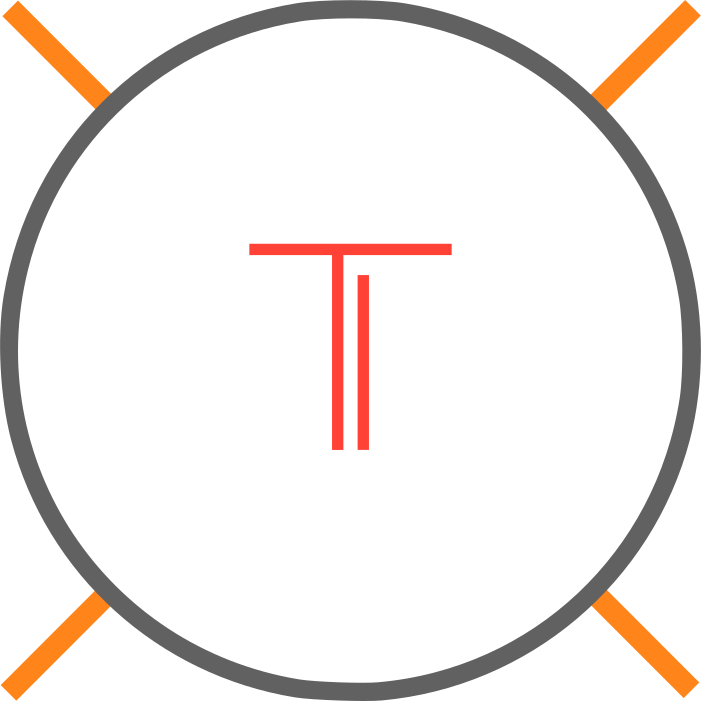
(c) rotates around the -axis
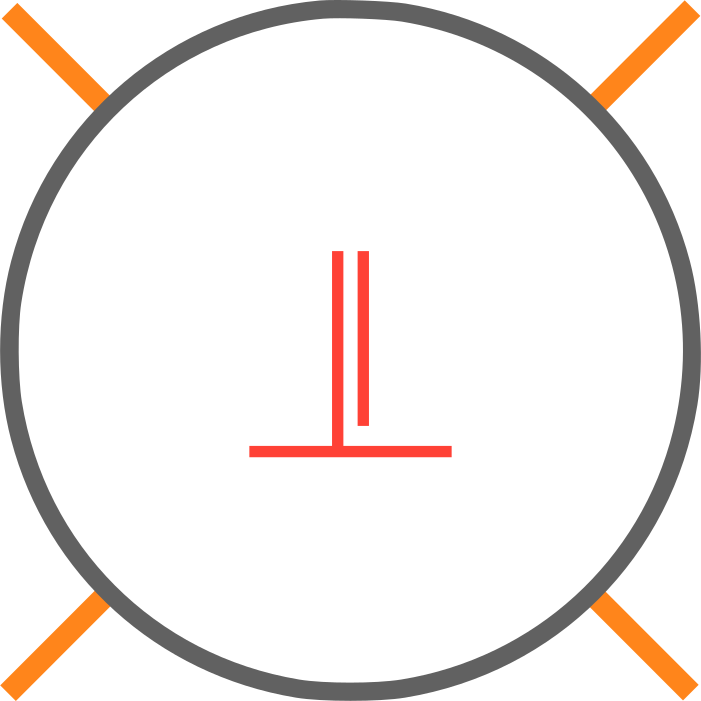
(d) rotates around the -axis
Figure 19:Roations of a tangle.
6.2.2.2Anatomy of a tree
In this subsection, we will describe several portions of weighted planar trees: the ring subtree, essential vertex, and the sticks of a tree.
Ring subtree
We will now describe the ring subtrees of a weighted planar tree, which locally appear as Figure 20.
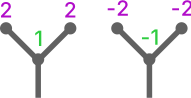
Figure 20:Positive and negative ring subtrees
Now, resolving the plumbing for the positive subtree, we arrive at bands as in Figure 21.

Figure 21:Plumbed ring bands
Notice that the boundary of these plumbed bands has three components, as seen in Figure 22.

Figure 22:Ring boundary
With an isotopy of the tangle and inversion of the Conway circle given by the non-plumbed square, we can arrange our plumbed bands into the standard tangle projection seen in Figure 23. This tangle projection tells us that the subtree in Figure 21 is, depending on location of , either the zero or infinity tangle with a ring.

Figure 23:Ring Tangle
Essential Vertex
We now classify each vertex into one of two classes, the essential vertices and the non-essential vertices.
As an example, consider the vertices seen in Figure 24.
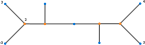
Figure 24:A weighted planar tree annotated with essential vertices in orange and non-essential in blue
Sticks of a Tree
The final part of the anatomy of a tree we will consider is the sticks of a tree.
As an example, consider the tree seen in Figure 24, the sticks of which can be seen in Figure 25.
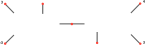
Figure 25:Sticks of the tree from Figure 24, six half-open sticks and one open stick.
By construction, a stick subtree of may have 0, 1, or 2 free bonds (seen in Figure 26). We call a stick with 0 free bonds closed, 1 free bond half-open, and 2 free bonds open. Additionally, we call a stick where each vertex has a single weight a proper stick, and we call a vertex on the end of a stick an end vertex.
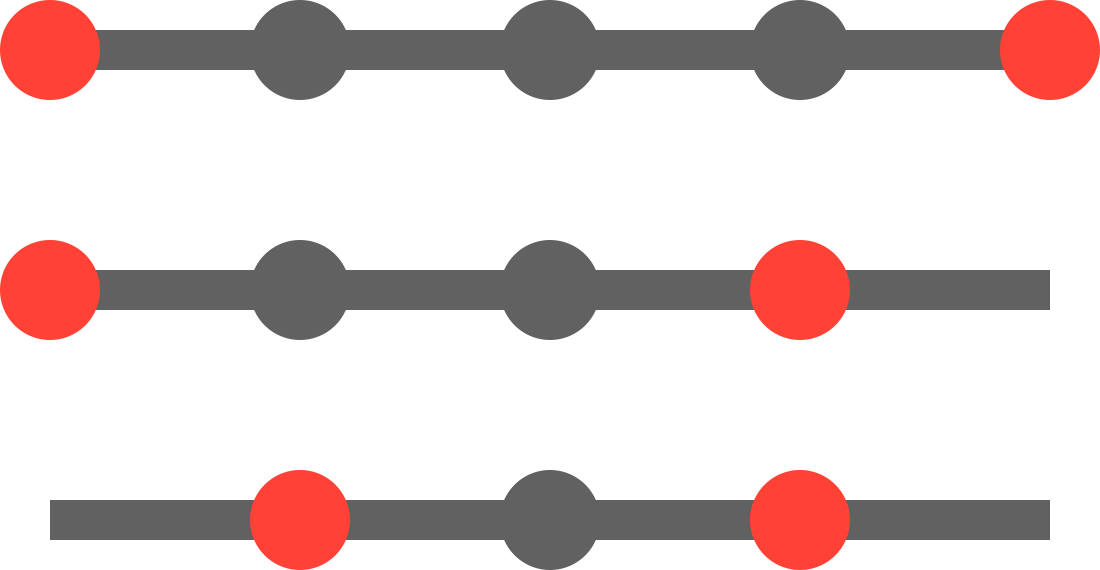
Figure 26:From top to bottom, a closed, half-open, and an open stick. Each end vertex is colored in red.
Integral Tangles
When a weighted planar tangle tree is a half-open stick containing a single vertex with a single weight we call it an integral tangle tree.
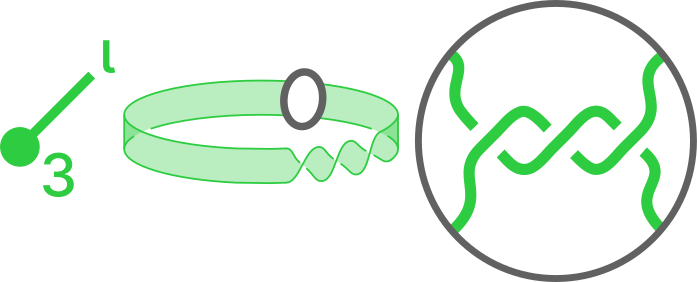
Figure 27:A stick realized as an integral tangle.
Rational Tangles
Bonahon and Siebenmann 8 give a correspondence between stick tangle trees (a stick with a single free bond) and Conway’s rational tangles 1. An example of the correspondence can be seen in Figure 28.
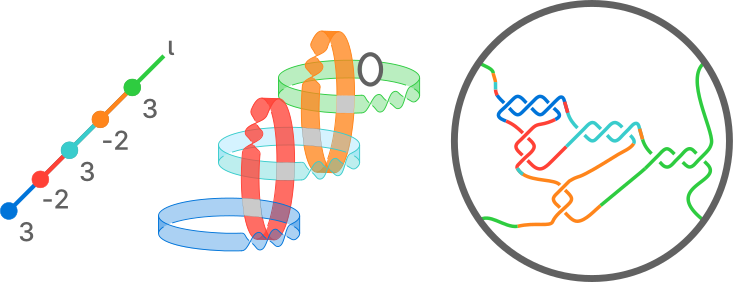
Figure 28:A stick tangle tree realized as a rational tangle.
Tree Crossing Number
Finally, we define the Tree Crossing Number (TCN) of a weighted planar tangle tree. This corresponds to the crossing number of the tangle diagram given by the weighted planar tangle tree.
6.2.2.3Calculus of Weighted Planar Trees
This subsection develops a set of moves, , and , on the weighted planar trees described in Weighted Planar Tangle Trees. We will restrict our discussion to a subset of the calculus of weighted planar trees. A full description of the calculus can be found in Bonahon and Siebenmann 8. The moves allow us to systematically modify, without changing the topology, a weighted planar tree and form the basis for the classification of the arborescent knots.
The Move
The first move, and as we will see, the most important in distinguishing tangles, is the move. In this move we consider the local picture of a vertex. In the local view, isolate a single bond (half-edge corresponding to a plumbing square of a band), then move a weight across that bond. The impact of this movement of a weight propagates to the descendants of the subtree attached to the bond (plumbing square) but leaves unchanged all other weights and bonds (including their attached subtrees) in the local view of the object vertex.
The move is a derivative of the more general move described in Bonahon and Siebenmann 8.
We will now consider some examples of the move. While we explore these examples, we view from the perspective of an object vertex (object band). The object vertex may have one or more children that we will act on with . When we translate and into practice we are free to operate on children as well as the parent of a vertex (band).
on bands
The translation of crossings across child bands models the traditional flype move of “Tait Flyping Conjecture” 13 fame. To see the correspondence between and flype we need to view the plumbed child (or parent) band as a tangle, . We can then carry out over this tangle. Tracking the parts of this operation, we can see the correspondence in Figure 31.
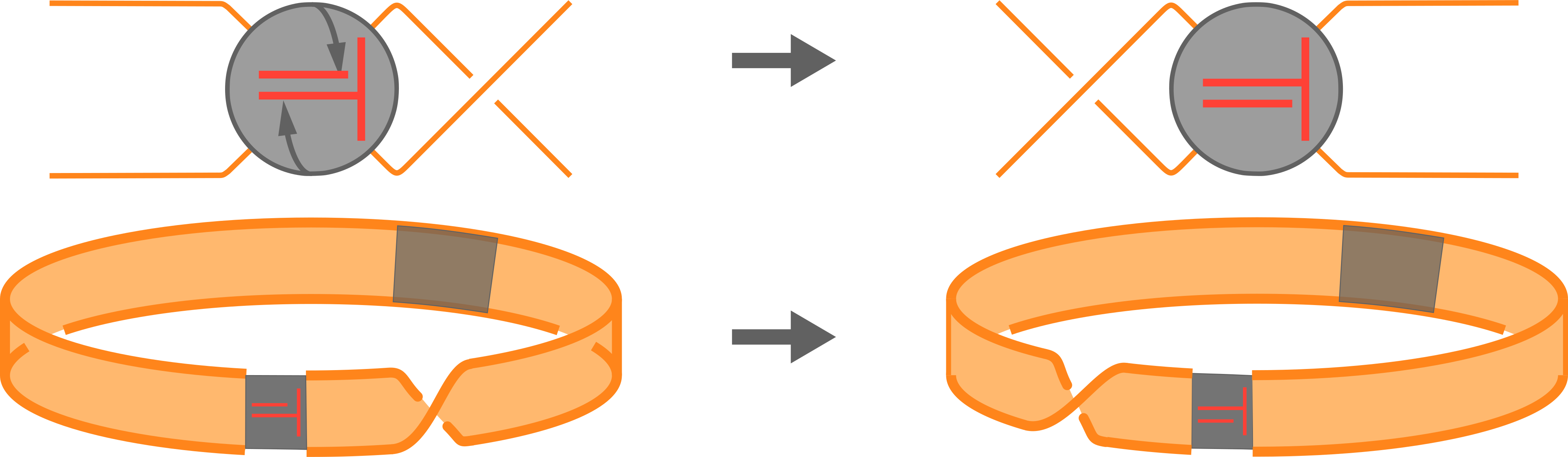
Figure 31:Flype and , with orientation of the Conway sphere given by Weighted Planar Tangle Trees
When this is carried out, for an odd number of crossings, the child band is inverted so it lies inside the parent band (Figure 32). The inversion reverses the cyclic order of the child, as described in Definition 18.
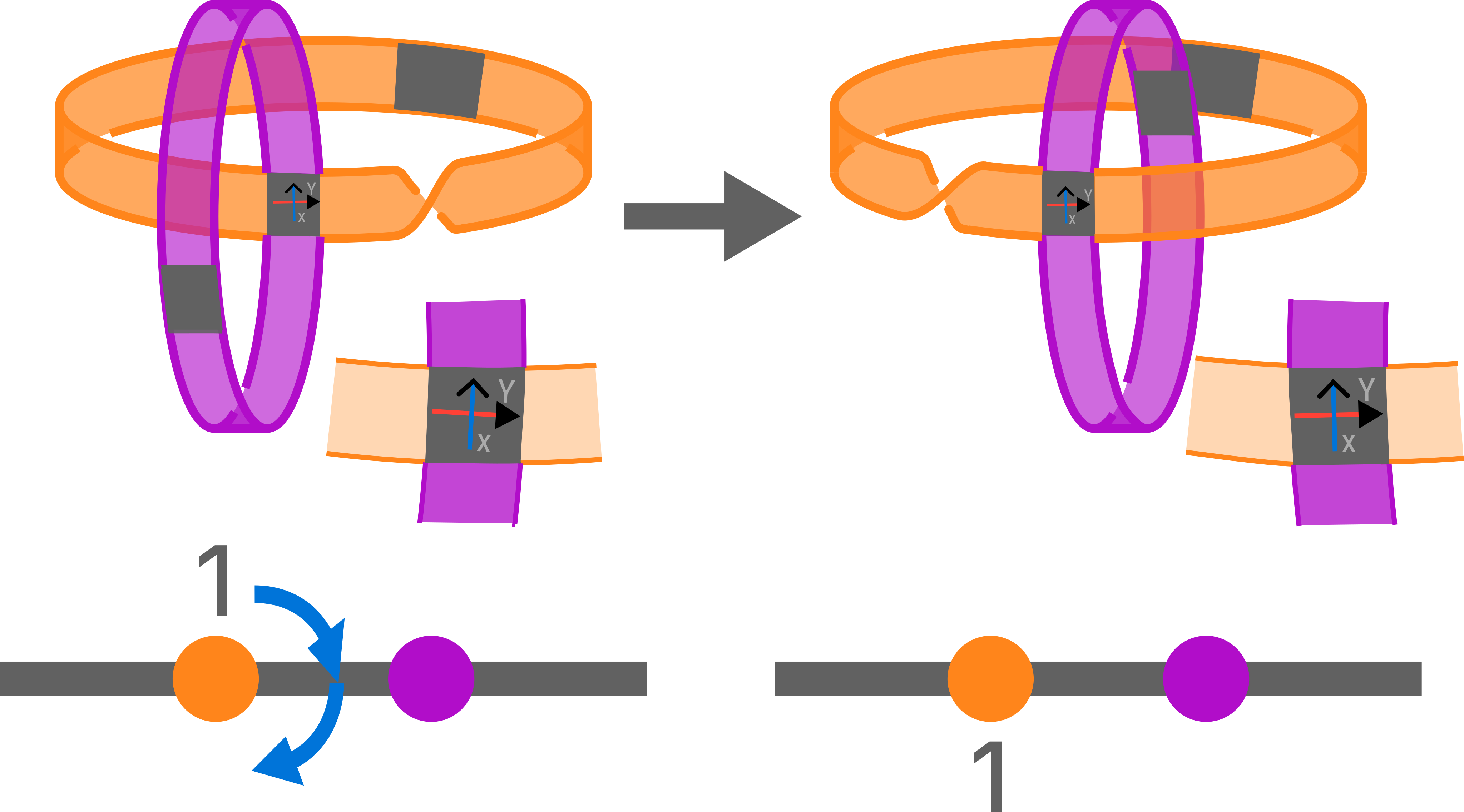
Figure 32:The odd case on a band model realization of the given portion of a tree, with local -axis in blue and -axis in red given relative to the purple band. Yielding a (-axis rotation) to all bands plumbed to the purple band or plumbed at even distance (counting plumbing squares) from the orange band, and (-axis rotation) to the purple band and those plumbed at odd distance from the orange band. Note that the orientations of the plumbing squares must agree before and after . Following the orientations with the left hand (Figure~\ref{wpt-construc-fig-band_orientation}) rule shows the orientation of the purple band reverses in and in the second image due to the rotation in (we are no longer looking through the band in the second image).
Applying to an even number of crossings is equivalent to applying the move on two sets of an odd number of crossings. When the first set of odd crossings is applied, the child band is inverted; the second set inverts the child again, leaving it where it began (Figure 33).
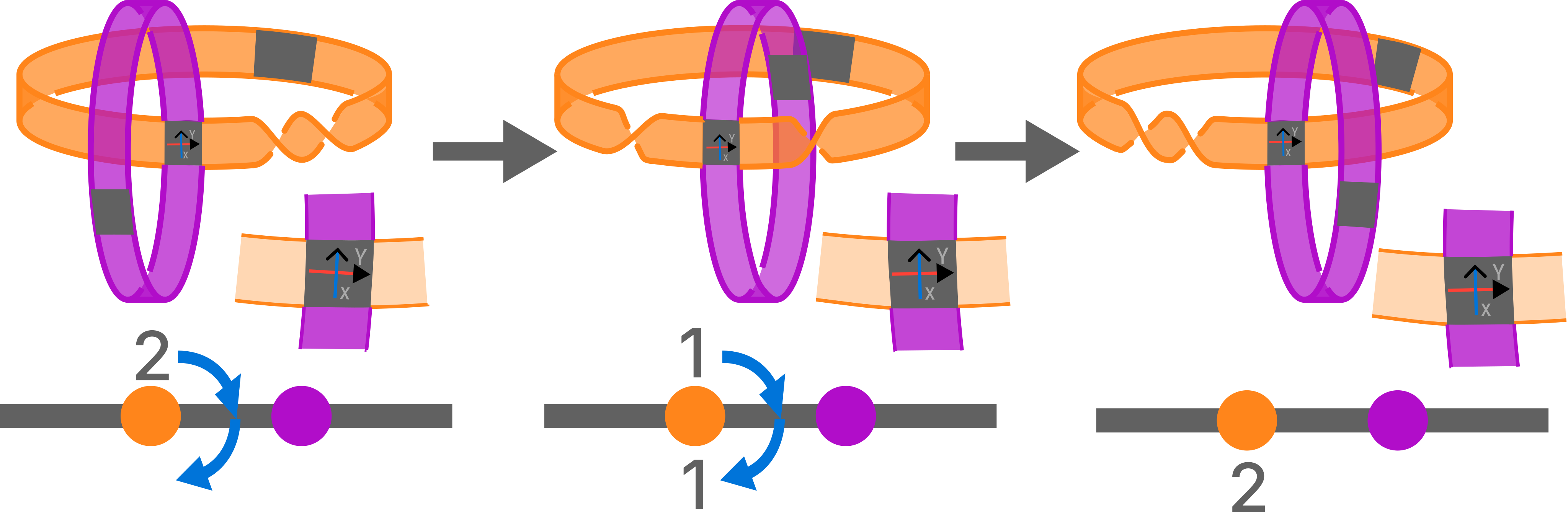
Figure 33:The even case of the with the purple band and any descendants of the purple band remaining unchanged.
We expand to an example where the child band has descendants, as in Figure 34. Observe that when the is applied in this case, the child band and every band even distance from it (odd distance from the parent) are inverted.
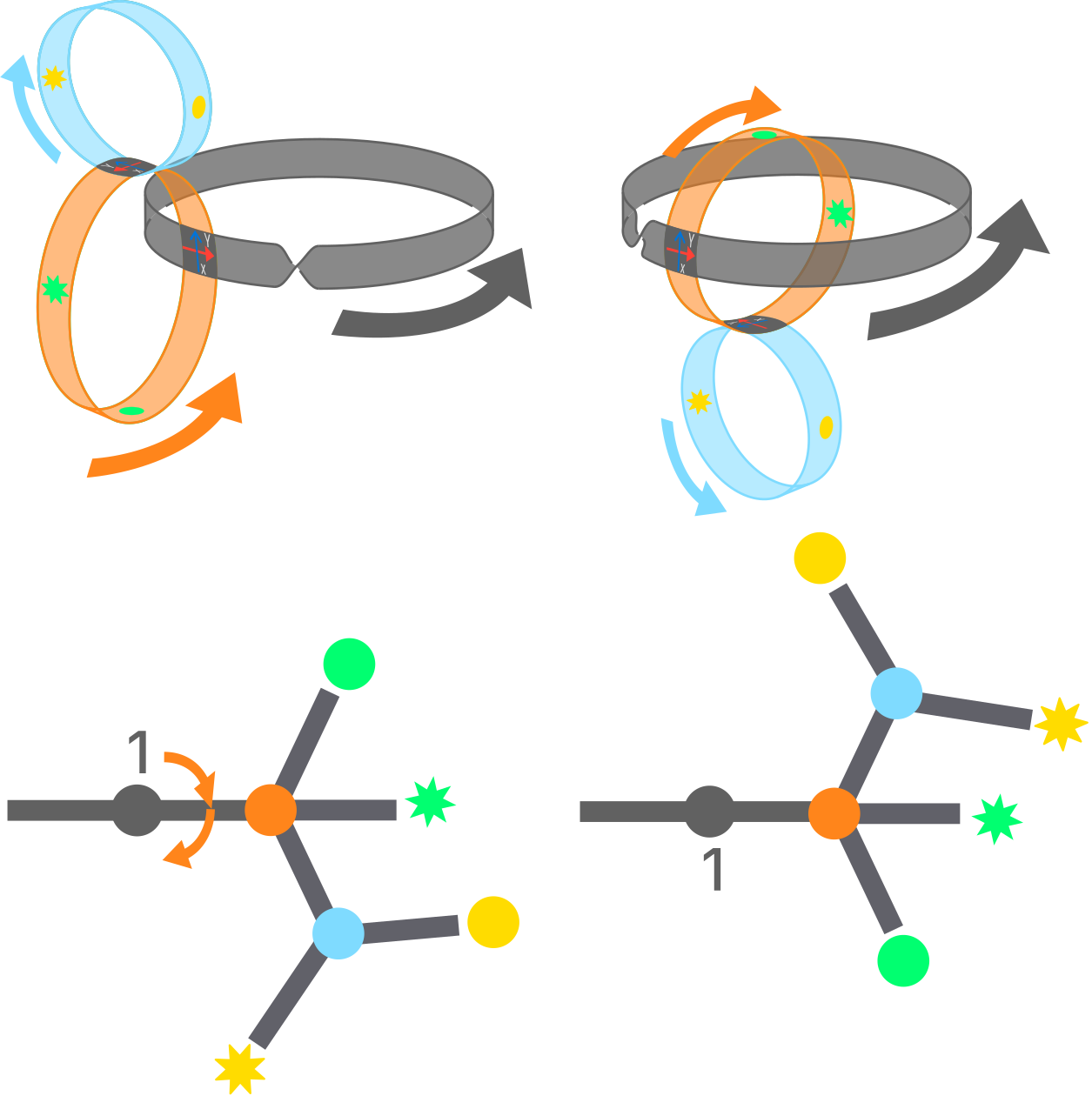
Figure 34: when applied to a band (gray) with a child (orange) and grandchild (light blue). We read the bands following the local orientation of the plumbing squares. Before the move is applied, the child (orange) band is traversed as; the blue band, a green star, a green circle, and back to the parent. After it is traversed as; a green circle, a green star, the blue band, and back to the parent. The blue band is traversed as; yellow star, yellow circle, and back to orange band.
Examples
Consider the weighted planar tree in Figure 35 and Figure 36, the left trees in each agree in all but a weight of a single vertex, what we will call our object vertex which is marked in orange. The weight of this object vertex has been changed from -2 in Figure 35 to -3 in Figure 36.
We will first walk through Figure 35. In this example, our object weight is even, applying to the tree, the impacted subtree (purple subtree in Figure 29) is unchanged except for free bonds, which are altered as described in Definition 18.
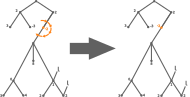
Figure 35: on a weighted planar tree with even weight. The weight of the object weight is even, so the impacted subtree is unchanged.
In Figure 36, the object weight is odd, applying the cyclic order of vertices of the impacted subtree at an odd distance are reversed. Additionally, all free bonds in the impacted subtree are altered as described in Definition 18.
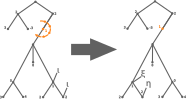
Figure 36: on a weighted planar tree with odd weight clockwise. Note the changes in the relative positions of subtrees after the application of .
The Move
Our second move, , is a special application of the general move.
is equivalent to applying to a vertex by moving a weight around a full cycle of the children (and parent), as in Figure 37a. If the vertex has no weights, the zero weight is split into +1 and -1, one of which completes the cycle. The +1 and -1 then cancel, returning the vertex to zero weight. The result of carrying out on a weighted planar tree can be seen in Figure 37b.
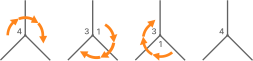
(a) moving a weight in a complete cycle
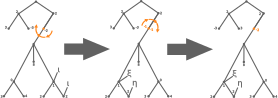
(b) on a weighted planar tree. Observe the changes to the entire tree, as opposed to the changes of which impact only a subtree.
on a WPT
Observe that vertices can be partitioned into two equivalence classes. Those changed by applied at an even distance from the root, and those changed by applied at an odd distance from the root. We write on the even class as and odd as .
The Move
The third of the moves is the move, which is a repeated application of the move.
To realize as moves, we successively apply and then to the tree. Observe that the combination of and modifies the free bonds by .
The moves
The move, or ring move is the final move we will describe on weighted planar tangle trees and deals with the ring subtrees of a tree. The result of a ring move on a tangle can be seen in Figure 38.

Figure 38: on on a tangle representation of a tree.
6.2.2.4Canonical Weighted Planar Tangle Trees (CWPTT)
Observe that the weighted planar tangle trees we have seen are badly non-unique representatives for arborescent tangles. The first step to finding a unique preferred representative is to put some additional conditions on a weighted planar tree, . The following conditions pare down the equivalence class of an arborescent tangle to a more manageable level.
Bonahon and Siebenmann show in Corollary 1 that these conditions are sufficient to realize every arborescent tangle. In fact, every weighted planar tangle tree can be turned into a CWPTT by a series of moves in an extended calculus on weighted planar trees 8. We call this process canonization of a weighted planar tangle tree.
We note some consequences of the positivity and negativity condition. First, a positive CWPTT (-CWPTT) can be transformed by a sequence of moves in the extended calculus of weighted planar trees into a negative CWPTT (-CWPTT). Similarly, a negative CWPTT can be transformed into a positive CWPTT. Second, we note that a CWPTT, with no modification, can be both positive and negative. We will refer to these trees as neutral trees.
Bonahon and Siebenmann give a classification of arborescent tangles via moves on CWPTT.
Further, Bonahon and Siebenmann describe an algorithm for producing these sequences of moves. This algorithm will be useful to us in Section 6.2.4.2.
Canonical Vertex
The conditions for a weighted planar tree to be a CWPTT are phrased for the global context of a weighted planar tangle tree. We now recontextualize those conditions for a local view, a single vertex of the tree.
From this definition, we now show that these conditions are identical to those in the global context of Definition 24.
The definition and proof for -canonical vertices are identical. Similarly to the canonical tree case, we define a third positivity class for a vertex, the neutral vertex, a vertex that is both -canonical and -canonical.
6.2.2.5Minimalization of CWPTT
CWPTT are Not Minimal
A common measure for the complexity of knots and their relatives is the minimal crossing number. That being the least number of crossings needed to realize the object in a diagram, we call that diagram the minimal diagram. It is natural to ask if our CWPTT are minimal representatives among either all representations or arborescent representations. A quick analysis of the process of canonization demonstrates that CWPTT are unfortunately far from minimal even among arborescent representatives. An example of canonizing a tangle, making that tangle non-minimal, is seen in Figure 44a.
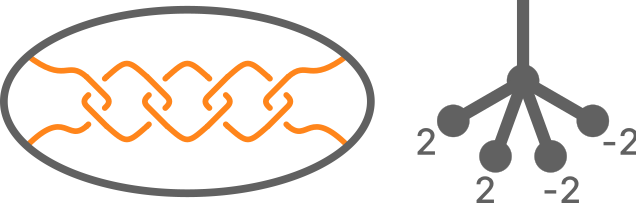
(a)A minimal presentation of a arborescent tangle in both its orthogonal projection as well as its weighted planar tree.
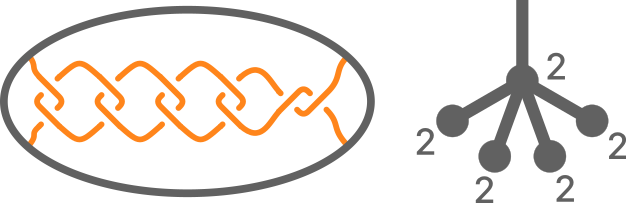
(b)A non-minimal presentation of the same arborescent tangle as Figure 44a in both its orthogonal projection as well as its CWPTT.
Figure 44:Minimal and non-minimal trees.
Canonization Can Increase Complexity
As we have seen, a CWPTT often does not realize a minimal crossing representative for an arborescent tangle. Since minimal crossing number is such a common measure for complexity, we should understand how canonization impacts the crossing number complexity of a CWPTT. We will accomplish this by identifying a (non-unique) minimal arborescent representative for each tangle. That is, a weighted planar tangle tree with minimal TCN among all weighted planar tangle trees in its equivalence class. To begin we expand our understanding of the moves in the calculus of arborescent tangles to those that alter weights arithmetically. These moves are related to the arithmetic operations on continued fractions 8.
From here we will show that canonization of minimal trees increases TCN complexity in a controlled manner.
We note that Theorem 6 indicates that any opportunities to decrease TCN in a CWPTT are found on the end vertices of sticks adjacent to an essential vertex. Particularly, at least one weight used in the execution of 1.2, 2.1, and 2.2 must be carried by an essential vertex. Reversing the sequence of moves in Theorem 6 tells us that a minimal tree can be constructed from a CWPTT by application of TCN decreasing moves 1.2, 2.1, and 2.2. It is important to note that this does not guarantee that every set of applications of the 1.2, 2.1, and 2.2 moves to a CWPTT minimizes the TCN, only the existence of a path to a minimal tree.
Bounding complexity
We now introduce a bound on complexity between a CWPTT and a minimal representation of that tree. We build the bound by identifying the maximum number of subtrees of a CWPTT which admit a 1.2, 2.1, or 2.2 move. We begin by identifying the smallest TCN of a subtree that admits each move. These minimal subtrees follow directly from Definition~\ref{minimal-def-arithmetic} and our essential vertex requirement. The smallest, by TCN, canonical subtree admitting move 1.2 is 7, as in Figure 51a. For move 2.1 the smallest TCN for a canonical subtree is 5, as in Figure 51b, and for 2.2 the smallest TCN is 10, as in Figure 51c. Combining these smallest TCN subtrees with the how each move decreases TCN gives the bound in (11), where is a minimal representative for the tangle class of .
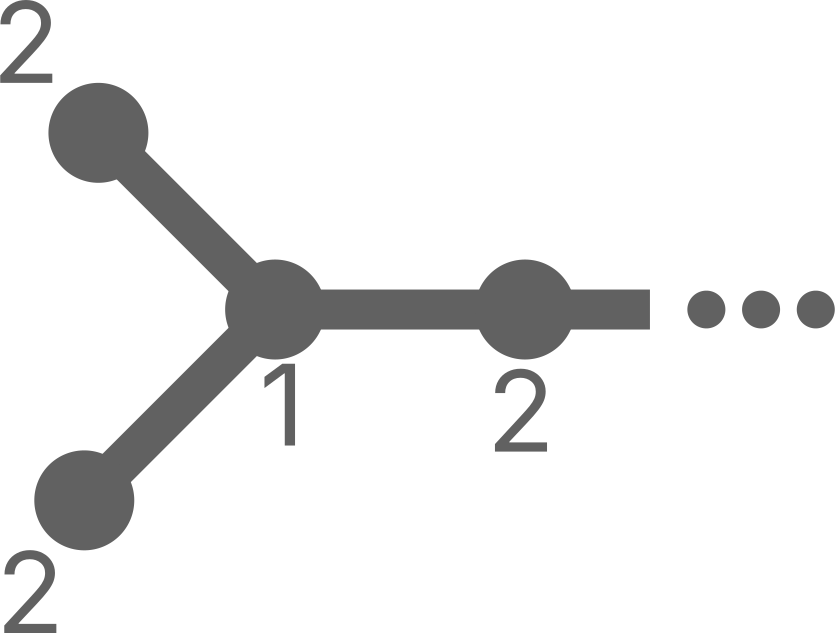
(a)Admits move 1.2
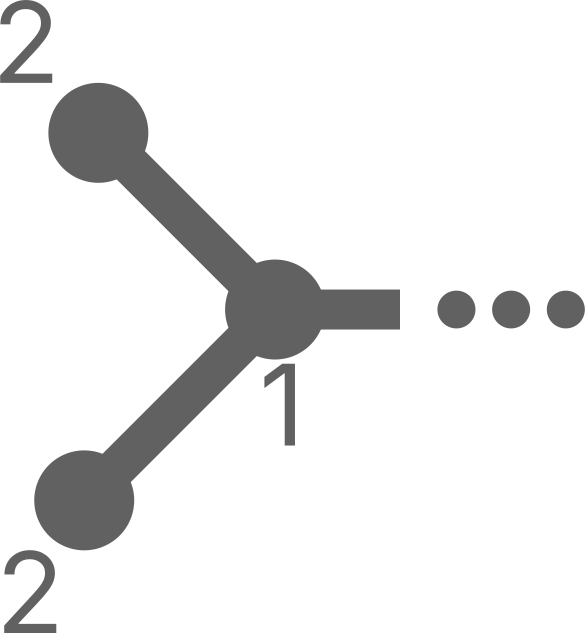
(b)Admits move 2.1
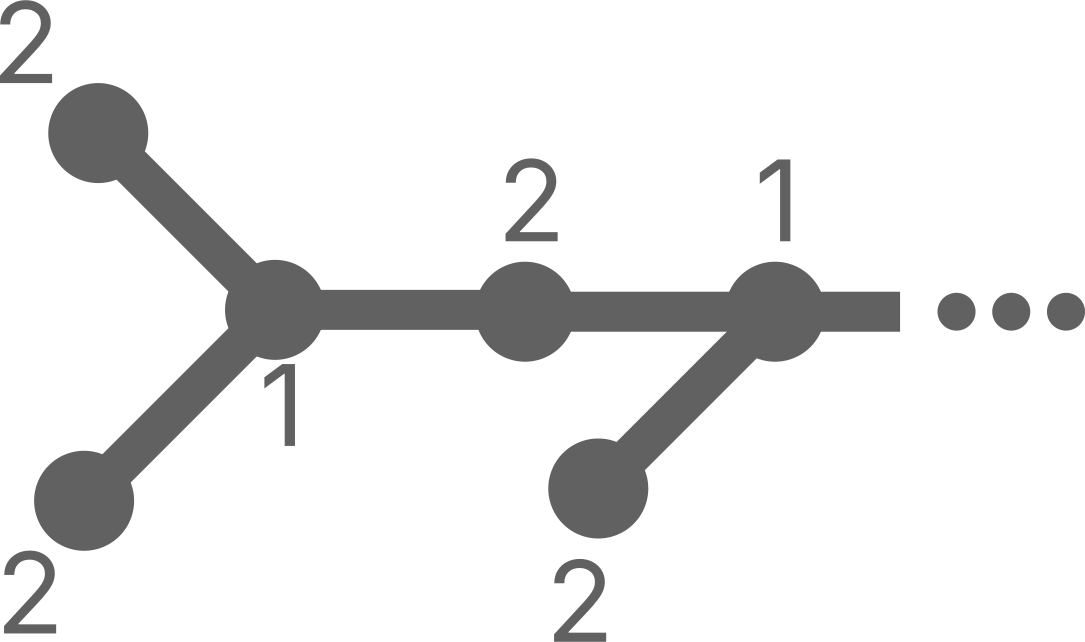
(c)Admits move 2.2
Examples of canonical subtrees of a -CWPTT which admit the given moves. Note: These are subtrees admiting the moves, but not the only subtrees admiting the moves.
6.2.3Right Leaning Identity CWPTT
The CWPTT are sufficient for distinguishing any two arborescent tangles via moves on their trees. Unfortunately, the equivalence class of CWPTT is still too large for computational enumeration to be feasible. The time required for pairwise comparisons grows badly exponentially. Luckily, from the class of CWPTT for an arborescent tangle, we can select a unique preferred form that allows for efficient direct enumeration by computer. To achieve this we will define two additional conditions for CWPTT, first the right leaning condition, and second, the identity condition. We call these preferred CWPTT Right Leaning Identity Canonical Weighted Planar Tangle Trees (RLITT).
6.2.3.1Existence of Right Leaning CWPTT
We start our construction of RLITT by defining what conditions make a CWPTT a right leaning CWPTT.
Our next step is to show that every arborescent tangle has a right leaning representative.
6.2.3.2Existence of Identity CWPTT
Our second step in the construction of RLITT is to define what conditions make a CWPTT an identity CWPTT.
Again, we must show that every arborescent tangle has an identity representative.
6.2.3.3Existence of Right Leaning Identity CWPTT (RLITT)
What we have shown is that every arborescent tangle has at least one right leaning CWPTT and at least one identity CWPTT representative. Combining these two ideas, we will show that every arborescent tangle has at least one CWPTT that is right leaning and identity, we call such a CWPTT an RLITT.
6.2.3.4Uniqueness of Right Leaning Identity CWPTT
Our final step at identifying a preferred representative CWPTT of an arborescent tangle is to show that a -RLITT is unique in the set of CWPTT representing an arborescent tangle. We will utilize the key proposition from Bonahon and Siebenmann 8 a consequence of Theorem 3 and Theorem 4.
6.2.4Computational Methods
6.2.4.1An Encoding Strategy for Arborescent Knots and Tangles
The various flavors of weighted planar trees we have seen thus far are a useful tool for manipulation of arborescent tangles by humans or machines. Unfortunately, the tree structure is quite difficult to store directly in a computer database. We will rectify this by introducing a linearization strategy for weighted planar trees. This linearization strategy is designed to encode not only CWPTT but arbitrary weighted planar tangle trees. If a weighted planar tangle tree has more than one free bond we list the label as a subtree. We will omit this from our algorithm description as we are primarily concerned with RLITT.
We will descend the tree following the indexing of the total order (Indexing the total order of a tree). As we descend the tree, we annotate the linearization with two sets of delimiters. Each delimiter communicates extra information about the type of subtree it is delimiting, the two sets of delimiters are as follows:
: Corresponds to a half-open proper stick and is interpreted as a twist vector for a rational tangle Kauffman & Lambropoulou (2002).
: Corresponds to a vertex not on a half-open stick.
We will now walk through an example of the linearization algorithm. Let be a weighted planar tangle tree seen in Figure 52. As we walk the tree, the vertex currently being linearized will be called the object vertex.
Tangle Linearization Example
We begin by adding the label for our tangle to the linearization. We then start the following algorithm with the root as the object vertex.
For the object vertex, we add a ‘’ delimiter to our linearization. Adding to our linearization the weights and children of the object vertex in an anti-clockwise order. When a child bond is encountered, we descend to that child. When we descend, we have two cases to consider, the child is a half-open proper stick or otherwise.
Case 1: The Child Is The Root Of A Half-Open And Proper Stick
When the child is the root of a is proper and half-open (contains a leaf vertex), we append that stick as the twist vector (Definition 2) for the corresponding rational tangle. Let the stick consist of the vertices, , and weights, . We delimit the stick with , with each weight separated by a space, and the leaf weight as the left most entry of the twist vector. Further, every other entry is multiplied by -1, forcing the sign of all entries to match, as in (12).
Case 2: The Child Is Essential, On A Open Stick, Or On A Non-Proper Stick
In this case, we restart the algorithm from the beginning with the current vertex as the object vertex.
When we have exhausted the children for the object vertex, we close our linearization for that vertex with the delimiter ‘’. We then return to the parent linearization, repeating until all vertices have been exhausted. An example of a tree encoded with this strategy can be seen in Figure 52.
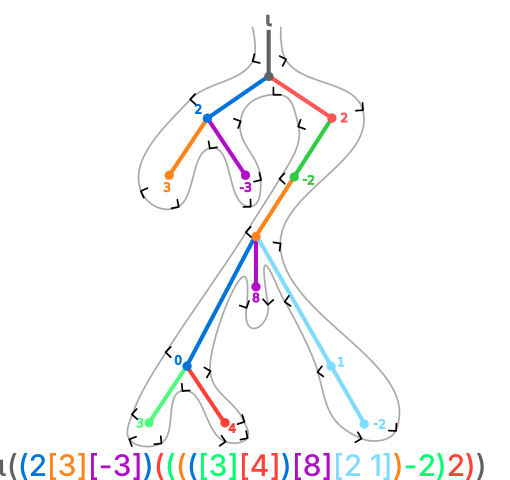
Figure 52:Encoded tree subtrees are indicated by color.
6.2.4.2Generation of Right Leaning Identity Weighted Planar Tangle Trees
Generation of Rooted Plane Tree
Just as rooted plane trees serve as the scaffolding we built WPTT on, a rooted plane tree algorithm will serve as the backbone for our RLITT generation algorithm. We will now give a brief description of the generation algorithm for rooted plane trees given by Nakano 14. We begin by defining the rightmost path of a rooted plane tree .
Next, we define a grafting operation on rooted plane trees and .
Now we are prepared to give the algorithm to generate all rooted plane trees of a given size that are created from by a sequence of operations on the rightmost path of .
This algorithm can be extended to an algorithm that finds all rooted plane trees up to a given size as follows.
Modification for RLITT
The algorithm described above serves as the inspiration for the algorithm we will build now for the enumeration of the arborescent tangles. Building this algorithm begins with modifying the grafting operation to operate on weighted planar tangle trees as follows.
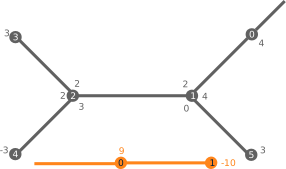
(a)A rootstock in grey and scion in orange. Each vertex is labeled with its index in the order on .
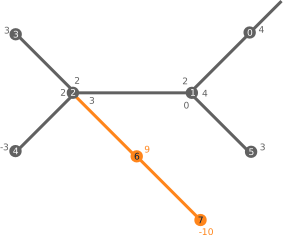
(b)Grafting at yields
Figure 54:Grafting trees.
Just as we have adjusted the grafting operator, we must adjust the Nakano algorithm so it is aware of the extra data in an RLITT. The initial reaction to this problem may be to simply annotate the scion of the grafting operation with the weights necessary to reach a target TCN. Unfortunately, this method quickly runs into issues generating even just the Montesinos tangles, a smaller class of tangle described by 8 We must make a slightly more radical change to the Nakano algorithm, that being, grafting an entire RLITT to only the root of the rootstock. We will now show that a list of integral tangles (single vertex RLITT) Section 5.3.3 combined with grafting at the root generates all -RLITT. To start, we will prove that each -RLITT is integral or the result of grafting weighted planar tangle trees at the root.
An identical theorem can be phrased for the -RLITT case. With this result, we can start our construction of a grafting algorithm for arborescent tangles.
Executing the algorithm with as the rootstock and produces the tangle . Unfortunately, this resultant tangle violates the stick condition and hence is not canonical. The remainder of this subsection will refine the grafting algorithm to satisfy each of the RLITT conditions.
Weight Condition
The simplest condition to verify is the weight condition. By construction, grafting the rootstock and scion introduces no additional weights at the grafting vertex. Meaning, the weight condition is satisfied with no adjustment to the algorithm.
Identity Condition
The next RLITT condition to address is the identity condition. We note that the operation does not modify the label of the rootstock. This observation means if the rootstock is identity, the grafted tree will also be identity.
Stick Condition
To start with the stick condition we will prove that if grafting produces a non-canonical tree the non-canonical vertex must be adjacent to the root.
The -RLITT case is shown identically, covering the majority of possibilities. However, we need to take special care when grafting a non-negative to a non-positive tree (or the reverse). Before we address that case we define a restricted class of scions that, after grafting, satisfy the nonzero portion of the stick condition.
Positivity/Negativity Condition
Our approach to the positivity and negativity condition follows our approach to the stick condition. We will leverage Theorem 12 to add a check for positivity and negativity in our algorithm.
Right Leaning Condition
Satisfying the right leaning condition is a consequence of the modified operation. Our definition of the operation grafts the scion in such a way that weights at are always right of the scion. To fully satisfy the right leaning condition, we need to ensure that any stick subtrees are in the right most positions. This is accomplished with a slight modification of our grafting algorithms.
Full Generation Algorithm
The algorithm we have developed so far generates new RLITT from two restricted collections of trees. Unfortunately, it doesn’t yet tell us how to select the collections that guarantee the generation of all arborescent tangles up to a target TCN are represented. The final step in the generation scheme is describing how to build these collections. With computer enumeration in mind, we would like for our strategy to be easily split into jobs that can be run in parallel.
We observe that when grafting , the TCN of and the TCN of sum to the TCN of . This observation is the key underpinning of the strategy we use to define discrete generation jobs. For a target TCN, we have the integer pairs seen in (13) that sum to the target TCN. Each of these pairs defines two classes, determined by TCN, of RLITT that can be grafted.
The next question we should ask is if we can simplify the list at all. First, as we saw in the discussion of the stick condition Stick Condition, we need our scions to be good. This means we cannot have 1 or 0 in the second position of the pair, excluding and from the list. Second, the pair will be excluded from our list, since the zero-crossing tangle can’t serve as rootstock; grafting any scion would violate the stick condition. We will recover tangles with root weight 0 with a post-processing step.
The following is the recursive algorithm used to take us from the set of RLITT with to the set of RLITT of the target TCN.
It is important to note that the output of Algorithm 15 includes duplicates in the form of -RLITT and -RLITT pairs. To deduplicate our list so it contains only topologically unique objects, we select from the list the collection of -RLITT.
Each tangle can be represented by an infinite number of diagrams. A unique representative in this context means a particular “flavor” of diagram that exists for every tangle in the class we are concerned about.
- Conway, J. H. (1970). An Enumeration of Knots and Links, and Some of Their Algebraic Properties. Computational Problems in Abstract Algebra, 329–358. 10.1016/B978-0-08-012975-4.50034-5
- Goldman, J. R., & Kauffman, L. H. (1997). Rational Tangles. Advances in Applied Mathematics, 18(3), 300–332. 10.1006/aama.1996.0511
- Rockett, A. M., & Szüsz, P. (1998). Continued Fractions (2. repr). World Scientific.
- Burde, G., Zieschang, H., & Heusener, M. (2013). Knots. DE GRUYTER. 10.1515/9783110270785
- Kauffman, L. H., & Lambropoulou, S. (2002). On the Classification of Rational Knots. arXiv: Geometric Topology. 10.48550/ARXIV.MATH/0212011
- Bryhtan, Z. C. (2024). Tabulating 2-String Tangles with Methods to Count and Generate Them. 10.25820/ETD.007313
- Ernst, C. (1996). TANGLE EQUATIONS. Journal of Knot Theory and Its Ramifications, 05(02), 145–159. 10.1142/S0218216596000114
- Bonahon, F., & Siebenmann, L. C. (2016). New Geometric Splittings of Classical Knots and the Classification and Symmetries of Arborescent Knots. https://dornsife.usc.edu/francis-bonahon/wp-content/uploads/sites/205/2023/06/BonSieb-compressed.pdf
- Connolly, N. (2021). Classification and Tabulation of 2-String Tangles: The Astronomy of Subtangle Decompositions. University of Iowa. 10.17077/etd.005978
- Caudron, A. (1982). Classification Des Noeuds et Des Enlacements. Université de Paris-Sud, Dép. de mathématique. https://books.google.com/books?id=W1nvAAAAMAAJ
- Gren, B. A., Sulkowska, J. I., & Gabrovšek, B. (2025). Classification of Algebraic Tangles. https://arxiv.org/abs/2504.06901
- Łukasiewicz, J. (1929). Elementy Logiki Matematycznej. Nakładem komisji wydawniczej Koła matematyczno-fizycznego słuchaczów Uniwersytetu warszawskiego.
- Tait, P. G. (1900). On Knots I, II, III. Scientific Papers London: Cambridge University Press, 1, 273–347.
- Nakano, S. (2002). Efficient Generation of Plane Trees. Information Processing Letters, 84(3), 167–172. 10.1016/S0020-0190(02)00240-5