There exists a common view of advanced mathematics as esoteric nonsense only understandable by elite thinkers. While that sentiment is perhaps deserved by some mathematical disciplines, knot theory is an area of advanced mathematics that offers deep significance as well as general accessibility. A lay person can be easily taught the basic structures of knot theory, while it takes years to master the details.
4.1An Intuitive Grounding in Knot Theory
A knot, when used in everyday life, is a tool whether it’s the “bunny ear” knot holding on your shoe, a decorative monkey’s fist on your key chain, or a climbing hitch securing yourself to a rock wall. Now, when thinking of these tool knots, we should note one critical attribute, they’re made of a single string with open ends (Figure 1). Notice with this construction, no matter how “knotted” the string, we can always pull on loops to remove the knot, leaving us with only an unknotted string.
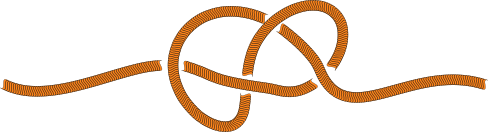
Figure 1:An everyday knot with open ends.
This leaves us with a somewhat unsatisfying construction, exactly one object, a string. How might we add some spice to our construction? What if we turn the string into a circle by gluing the ends as in Figure 2? When we try to wiggle the closed up string around, trying to remove the knot, we stretch and pull on the string, but regardless of what we do, we end up with a knot. Constructing a physical model of Figure 2 and playing with it should convince you that the knot can’t be removed. We call these closed up versions of knots mathematical knots.
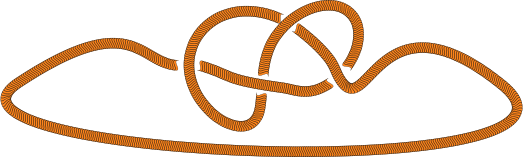
Figure 2:Closing the ends of the everyday knot in Figure 1 to form a mathematical knot.
With this, when compared to an everyday knot, we are already in a better place. Continue to experiment with your physical model by twisting the ends of the string around each other in different ways (Figure 4). You may discover that gluing the ends yields knots that can’t be maneuvered to look the same as Figure 2 or Figure 3.
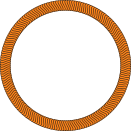
Figure 3:A representation of a simple loop made from gluing the ends of a rope together.
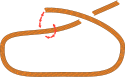
Figure 4:A representation of twisting the ends of a rope around itself before gluing.
In fact, this twisting gives us a whole infinite family of odd crossing torus knots, a sampling of which can be seen in Figure 5. A good exercise in building intuition is to convince yourself that the torus knots in Figure 5 are different from each other.

Figure 5:Three knots built from the operation seen in Figure 4. From left to right: three, five, and seven crossing torus knots.
Our experimentation with the physical model may conjure some questions, three important questions we may ask are:
“How do I systematically construct knots?”
“How do I tell two knots I make apart?”
“How do I generate new knots?”
Attempting to answer these questions, even just in part or with restrictions, is the bread and butter of knot theory and the focus of the rest of this thesis. Some great texts for continued reading on knot theory in order of accessibility are: The Knot Book: An Elementary Introduction to the Mathematical Theory of Knots by Adams 1, LinKnot: Knot Theory by Computer by Jablan and Sazdanović 2, Knots and Links by Rolfsen 3, and An Introduction to Knot Theory by Lickerish 4.
The remainder of this thesis quickly exchanges the idea of a knot for that of a tangle, introduced by Conway 5. A tangle can be thought of as slamming a cookie cutter onto a knot diagram pinning down four points. Once the knot is pinned down we then cut off the parts of the knot lying outside the cookie cutter, seen in Figure 6.
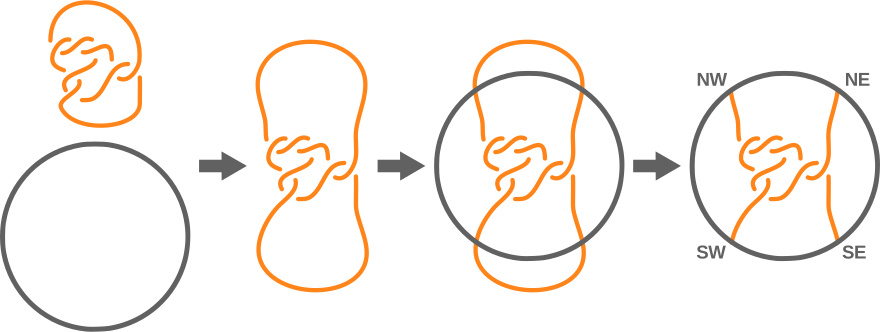
Figure 6:The creation of a tangle from a knot by cutting a section out of the knot but fixing four points.
4.2Brief Discussion on Applications
As we saw in Section 4.1, mathematical knots can be easily constructed as physical objects. It should be no surprise then that mathematical knots and tangles appear in the hard sciences, particularly in the realms of physics, chemistry, and biology. In this section, we will discuss one of the most commonly discussed applications of knot theory.
4.2.1Tangles in DNA
One of the fundamental features that identifies life as life is the ability to self-replicate. In order to self-replicate, life must have a mechanism to pass information to successive generations. Consider first the most basic self replicating component of life, called a cell. The information of a cell is stored as double-stranded DNA (dsDNA), as described by Crick, Franklin, Gosling, and Watson 67, a polymer consisting of two strands constructed from a sugar-phosphate connected to one of the monomers 6:
Adenine (A)
Guanine (G)
Cytosine (C)
Thymine (T)
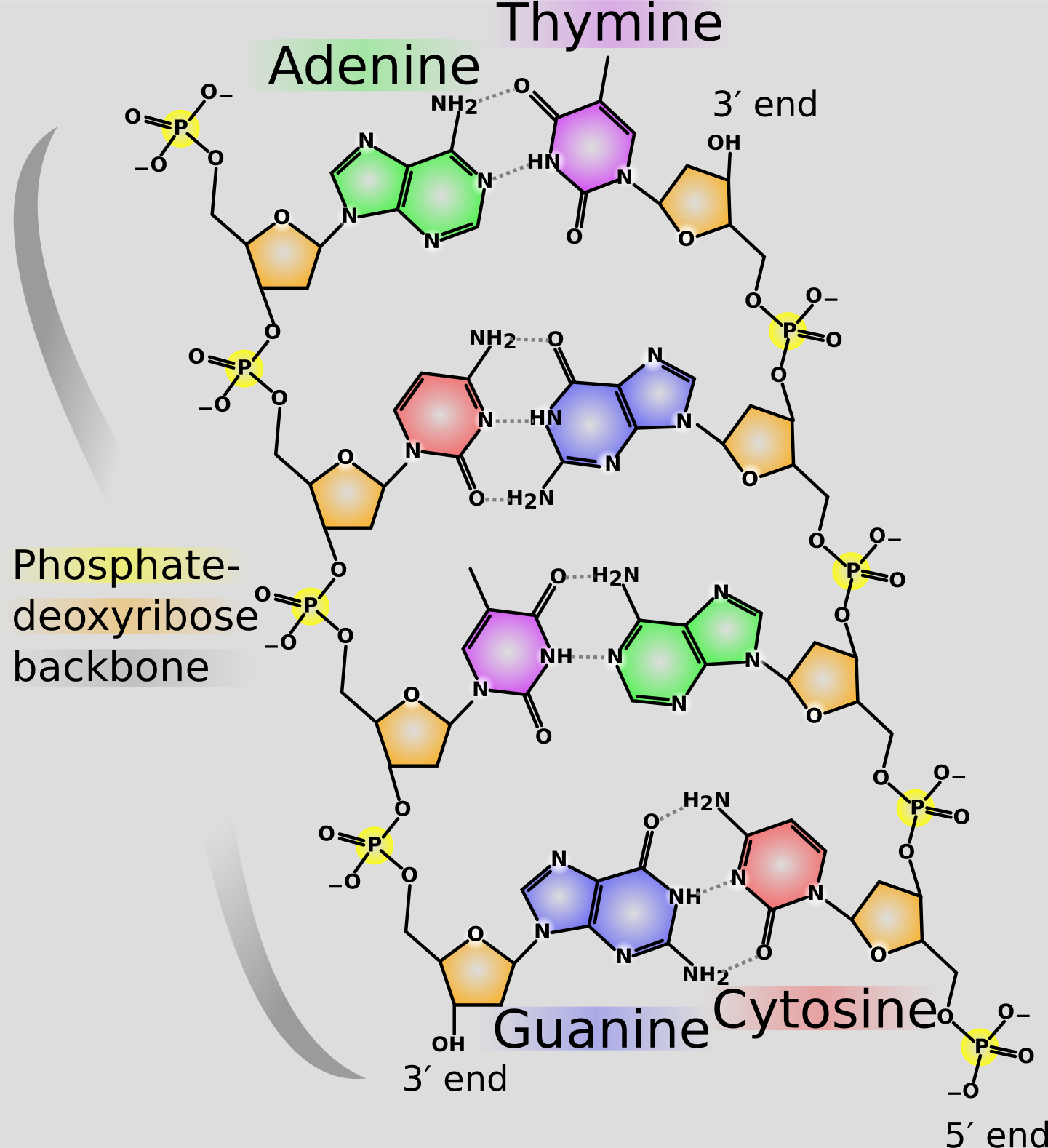
Figure 7:A schematic diagram demonstrating the structure of a dsDNA polymer (Ball CC BY-SA 2.5 via Wikimedia Commons 8)
The two strands of dsDNA connect to each other to form the “double-helix” where the monomers bind to each other with guanine (G) binding to cytosine (C) and adenine (A) binding to thymine (T) 6 (Figure 7). When replicating, the cell will duplicate the dsDNA by splitting the dsDNA into two single strands with the enzyme DNA helicase. Once the DNA is split, two new complementary single strands are constructed to be paired with each of the original single strands.
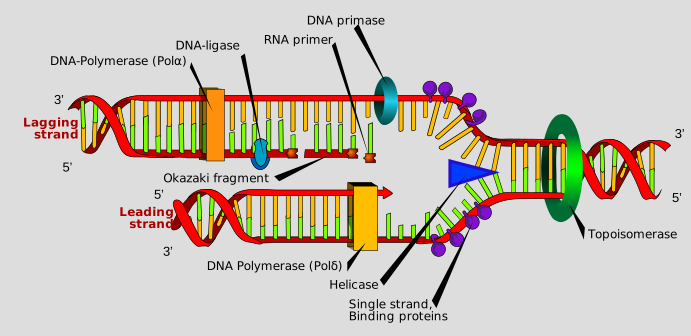
Figure 8:A schematic diagram demonstrating the splitting of a double strand of DNA into two new double strands. (Ruiz Public domain via Wikimedia Commons9)
The dsDNA of a cell needs to be physically stored inside the cell. Cell volume is limited, so organizing the dsDNA to fit in that volume requires several complex cellular mechanisms. One issue solved by these mechanisms is that of local knotting, which becomes a problem when the cell attempts to replicate. During the replication process, the DNA helicase begins splitting the dsDNA, but when the DNA helicase reaches the locally knotted portion, it becomes stuck, the replication will be unable to continue 10, and the cell will die. If this local knotting is allowed to happen unchecked, every cell would eventually be unable to replicate and would ultimately die. Famously, life finds a way, and one cellular mechanism that mitigates this local knotting problem is the enzyme type II topoisomerase 10.

Figure 9:A schematic diagram of the enzyme type II topoisomerase. (Sutor CC BY-SA 4.0 via Wikimedia Commons 11)
The enzyme attempts to solve this local knotting by cutting one of the dsDNA where two segments cross, then moving the top double strand to the bottom, this action can be seen in Figure 10.
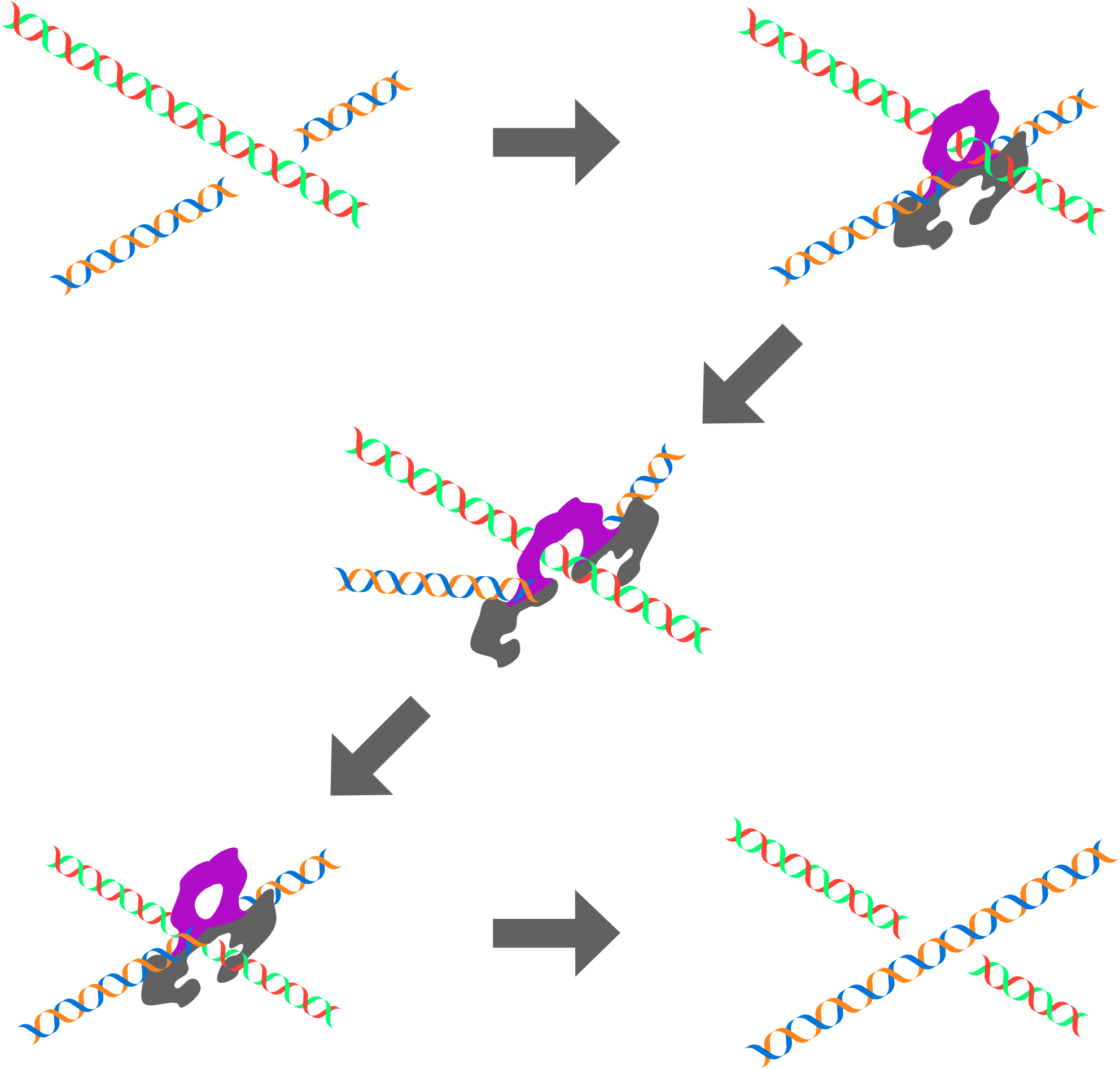
Figure 10:Type II topoisomerase doing a crossing exchange. From top left to bottom right: 1) A crossing of two dsDNA segments. 2) The enzyme grabs the under segment. 3) The enzyme splits the under segment. 4) The enzyme passes the over segments through the gap. 5) The crossing with the segments exchanged.
In mammals (and many other animal groups), dsDNA takes the form of long strings, which can only become everyday knots. However, it was discovered by Dulbecco and Vogt 121314 that in some viruses (Polyoma) the dsDNA is a closed loop, allowing it to form into a mathematical knot (Figure 11) .
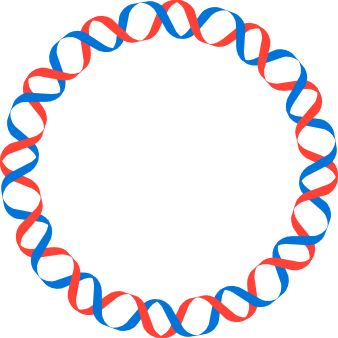
(a)A schematic diagram of circular dsDNA.

(b)A scanning electron microscope image of knotted dsDNA (Arsuaga CC BY-ND 15).
Figure 11:Schematic diagrams of circular and knotted dsDNA.
From here one may ask, “If the dsDNA is knotted and type II topoisomerase makes a change, what kind of new knot can this make?”, this question was addressed first by Ernst and Sumners in the 1990s 16 17. Their approach considers the dsDNA to be bounded by two “areas”, the first area is created by drawing a circle around the crossing that type II topoisomerase is working on (right side of Figure 12a), and the second by drawing a circle around the remainder (left side of Figure 12a). From here, the crossing change from type II topoisomerase can be modeled by changing the tangle bound in the area on the right (Figure 12), 18.
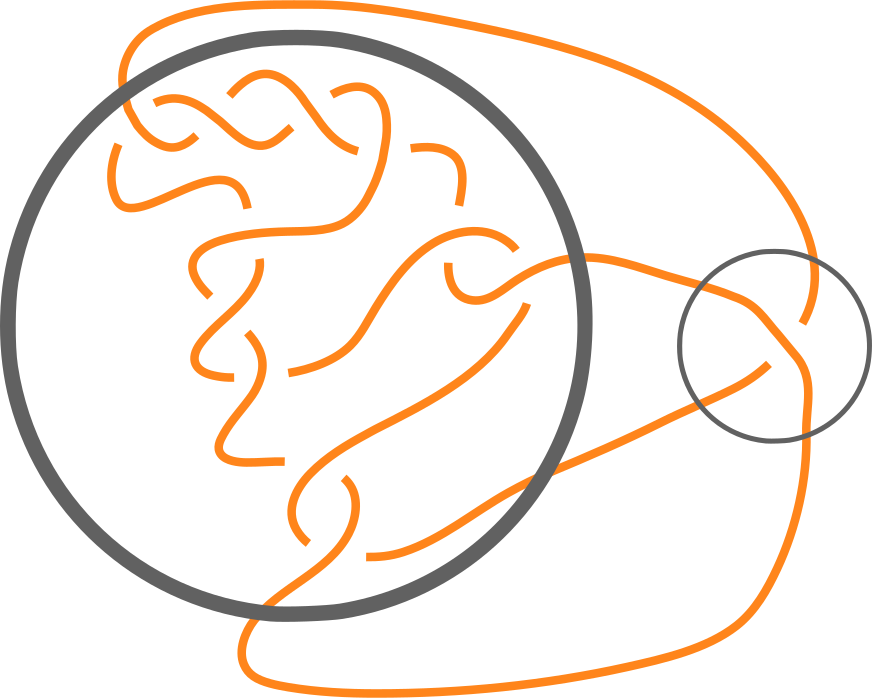
(a)A knot diagram showing two areas containing knot data. The right side contains the crossing that type II topoisomerase will work on.
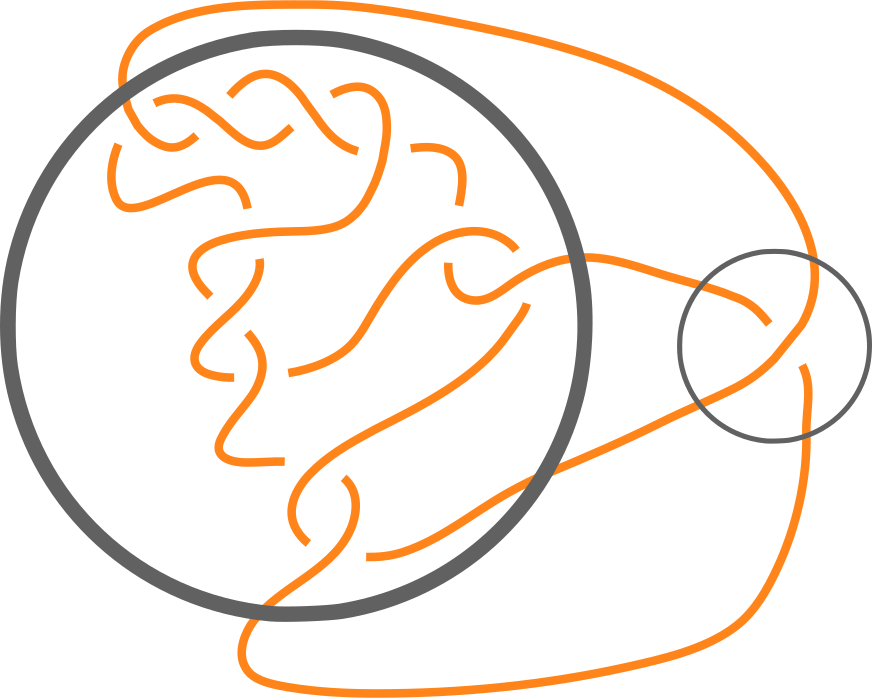
(b)A knot diagram showing two areas containing knot data. The right side contains the crossing that type II topoisomerase has worked on.
Figure 12:A tangle model for a crossing change in a knot.
The modeling of the action of type II topoisomerase is just one of the many applications for the theory of knots and tangles found in biology. For further reading on applications, a good source is the “Encyclopedia of knot theory”20, a survey of many subdisciplines of knot theory with a chapter devoted to applications.
4.3Overview of this Thesis
As discussed in the previous section, the goal of this thesis is to address, in part, the three questions “How do I systematically construct knots?”, “How do I tell two knots I make apart?”, and “How do I generate new knots?” Particularly, we will address a restricted version of these questions, for objects that can be thought of as the building blocks of knots, the tangles introduced by Conway 5. Through the middle of this thesis (Chapter 6 Tabulation), we will describe several strategies that have been employed to answer even further restricted versions of these questions:
“How do I systematically construct rational tangles?”, “How do I tell two rational tangles I make apart?”, and “How do I generate new rational tangles?”
“How do I systematically construct Montesinos tangles?” and “How do I tell two Montesinos tangles I make apart?”, and “How do I generate new Montesinos tangles?”
“How do I systematically construct algebraic/arborescent tangles?” and “How do I tell two algebraic/arborescent tangles I make apart?”, and “How do I generate new algebraic/arborescent tangles?”
While we could answer these questions about tangles with pen and paper brute force as Tait, Little, Kirkman, Conway, and Caudron 212223524 did for knots. Beyond a reasonable “crossing number” (Section 5.2.1), as small as 8, the time and effort needed makes pen and paper untenable. To achieve our goal in a reasonable time, we will follow a similar framework to that of Hoste, Thistlethwaite, Weeks, and Burton 252627. Utilizing computer methods to generate a tangle table of algebraic/arborescent tangles to twelve crossings. To effectively utilize computers for this tabulation work requires the design and implementation of a knot theory specific software toolbox.
4.3.1Chapter Summary
We will now summarize each of the chapters of this thesis. Organizationally, this thesis is partitioned into five chapters, with each chapter further divided into sections and subsections.
4.3.1.1Chapter 1: Introduction
This introduction gave an intuitive description of the basics of knot theory and a discussion of an application for knots and tangles. We now finish with this description of the content in the remainder of this thesis.
4.3.1.2Chapter 2: Preliminaries
This chapter gives the preliminaries in knot and tangle theory needed for the rest of the thesis. Included are the historical background of tabulation in knot theory and a grounding in knot and tangle theory. We will see definitions for knots and tangles, as well as some notations and invariants for those knots and tangles.
4.3.1.3Chapter 3: Tabulation
This chapter describes the theoretical methodology for the tabulation of algebraic tangles. It is divided into two sections, the first contains the method used for tabulation of two well-understood classes of tangles: the rational and Montesinos tangles. The second describes the methodology for the tabulation of the more general type of tangle the arborescent (algebraic) tangles. For each class of tangle we tabulated, a definition and classification is given, followed by a theoretical generation strategy.
4.3.1.4Chapter 4: Software and Its Engineering
This chapter addresses the computational and engineering aspects of software for mathematics research. The chapter begins with an overview of product management and software engineering practices. In our discussion of software engineering we develop a process designed for use by professional and undergraduate researchers in computational knot theory. With our process, we create a product design for a general purpose “knot theory software toolbox”. The chapter concludes with the software design (unit description) for the tools developed to realize the solutions in the tabulation section.
4.3.1.5Chapter 5: Future Directions
The final chapter of this thesis gives an overview of future work to be done in the tangle tabulation domain. This takes two forms, first the direct next steps for tangle tabulation at the professional research level. Second, we outline a collection of topics and research directions at various levels appropriate for undergraduate researchers.
- Adams, C. (2004). The Knot Book: An Elementary Introduction to the Mathematical Theory of Knots. American Mathematical Society.
- Jablan, S. V., & Sazdanović, R. (2007). LinKnot: Knot Theory by Computer. World Scientific.
- Rolfsen, D. (2003). Knots and Links. AMS Chelsea Pub.
- Lickorish, W. B. R. (1997). An Introduction to Knot Theory (Vol. 175). Springer New York. 10.1007/978-1-4612-0691-0
- Conway, J. H. (1970). An Enumeration of Knots and Links, and Some of Their Algebraic Properties. Computational Problems in Abstract Algebra, 329–358. 10.1016/B978-0-08-012975-4.50034-5
- Watson, J. D., & Crick, F. H. C. (1953). Molecular Structure of Nucleic Acids: A Structure for Deoxyribose Nucleic Acid. Nature, 171(4356), 737–738. 10.1038/171737a0
- Franklin, R. E., & Gosling, R. G. (1953). Molecular Configuration in Sodium Thymonucleate. Nature, 171(4356), 740–741. 10.1038/171740a0
- Price Ball, M. (2007). DNA Chemical Structure. https://commons.wikimedia.org/wiki/File:DNA_chemical_structure.svg
- Ruiz, M. (n.d.). DNA Replication Fork. RNA Primer. https://commons.wikimedia.org/wiki/File:DNA_replication_en.svg
- Alberts, B., Heald, R., Johnson, A., Morgan, D., Raff, M., Roberts, K., Walter, P., Wilson, J. H., & Hunt, T. (2022). Molecular Biology of the Cell. W.W. Norton and Company.
- Sutor, M. (n.d.). Scheme of DNA Gyrase Structure. https://commons.wikimedia.org/wiki/File:Gyrase_structure_Dmitry_Sutormin_eng.png
- Dulbecco, R., & Vogt, M. (1963). EVIDENCE FOR A RING STRUCTURE OF POLYOMA VIRUS DNA. Proceedings of the National Academy of Sciences, 50(2), 236–243. 10.1073/pnas.50.2.236
- Weil, R., & Vinograd, J. (1963). THE CYCLIC HELIX AND CYCLIC COIL FORMS OF POLYOMA VIRAL DNA. Proceedings of the National Academy of Sciences, 50(4), 730–738. 10.1073/pnas.50.4.730
- Vinograd, J., Lebowitz, J., Radloff, R., Watson, R., & Laipis, P. (1965). The Twisted Circular Form of Polyoma Viral DNA. Proceedings of the National Academy of Sciences, 53(5), 1104–1111. 10.1073/pnas.53.5.1104
- Arsuaga, J. (2013). DNA Knot as Seen under the Electron Microscope.